
Pharmaceutical innovation no longer relies solely on scientific discovery. In an increasingly competitive environment, operational efficiency has become a decisive factor in maintaining profitability and meeting time-to-market goals. Every day counts: production management, clinical trial planning, supply chain control, and resource allocation are all under constant pressure.
In this context, Artificial Intelligence becomes a strategic ally for operations departments. It’s not just about automating tasks or analyzing data — it’s about making better decisions, faster, and with greater confidence.

Advances in data science and machine learning have transformed the way the pharmaceutical industry interprets its data. Models can now detect patterns in time series, demand behaviors, or process variability—allowing organizations to anticipate deviations and prevent bottlenecks, while predicting what’s coming next with far greater accuracy.
The next challenge lies in closing the analytical loop: turning those predictions into operational decisions that optimize resources, timelines, and costs.
This is where mathematical optimization models come into play—transforming data into actions and recommending the best possible combination of resources, timing, and costs under real-world constraints (capacity, regulations, supply, etc.).
These models make it possible to:
- Simulate “what-if” scenarios before executing decisions.
- Balance multiple objectives, such as reducing costs without compromising quality.
- Coordinate teams and processes across the entire value chain.
The result: smarter, more connected, and more profitable operations, where machine learning and mathematical optimization work together to improve every decision.
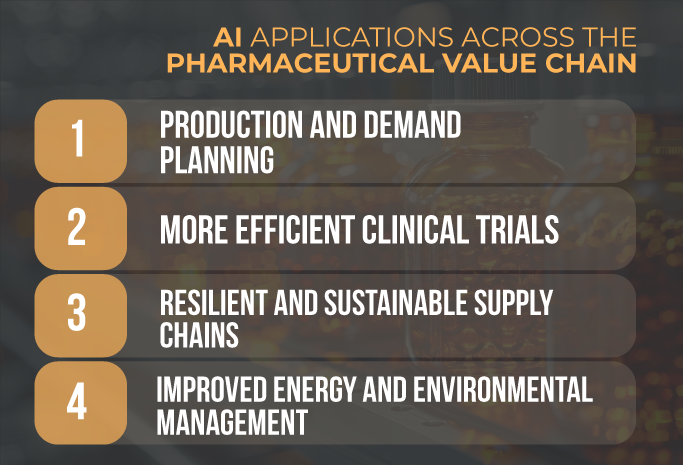
We call this custom combination of AI techniques—covering optimization, predictive modeling, and even Generative AI—Decision AI. Here are a few examples of where this technology has proven to be a game-changer:
Production and demand planning
Optimization models allow manufacturers to adjust production schedules based on real demand, plant capacity, and raw material availability.This minimizes changeover times, reduces inventory costs, and improves asset utilization.
More efficient clinical trials
AI can determine the optimal allocation of resources and the ideal location of trial centers based on patient availability, local regulations, and logistical capacity.The result is shorter timelines and a more rational use of human and financial resources.
Resilient and sustainable supply chains
In an environment where a supplier disruption or regulatory change can halt production, optimization models help design robust supply chains that balance cost, risk, and regulatory compliance.
Improved energy and environmental management
Optimization models can also help plan production shifts or equipment usage to minimize energy consumption—especially in energy-intensive processes or those with strict technical requirements.
The true power of Artificial Intelligence in operations lies not only in processing information, but in turning data into concrete decisions. Unlike predictive analytics—which answers “what will happen”—mathematical optimization answers “what should we do” to ensure that the outcome of our decisions delivers optimal operational performance.
This ability to recommend optimal actions makes AI an essential tool for planning, simulating, and executing complex operations with a much higher level of efficiency and control.
Real Use Cases
Multi-plant production optimization
A Decision AI model can determine which plants should produce each batch based on capacity, transportation costs, changeover times, and material availability. The result is a more balanced and profitable global production plan.
Integrated clinical trial planning
By combining historical data, regulatory criteria, and patient availability, AI can simulate multiple scenarios and identify the optimal combination of locations, investigators, and timelines — reducing delays and improving success rates.
In the pharmaceutical industry, every operational decision directly impacts innovation, costs, and the time it takes for medicine to reach the patient.
Decision AI doesn’t just improve efficiency — it transforms the way companies plan, produce, and deliver value.
If you’d like to learn more about how this technology can help in your specific case, you can schedule a personalized session to explore it further.