

Artificial intelligence is transforming the way companies make decisions. From banking to manufacturing, more and more organizations are using AI models to anticipate, optimize, and compete more effectively.
One of the concepts that emerges when we talk about AI is machine learning. In simple terms, machine learning is a branch of artificial intelligence that enables systems to learn from data. Instead of programming fixed rules, models analyze historical patterns and learn to predict or decide on their own—from estimating product demand to detecting fraud or recommending an investment.
According to the Bank of Spain, 19.9% of Spanish companies have already adopted AI solutions, and the trend is clear: adoption is growing, but there is still progress to be made. This is where explainability comes into play: the ability to understand why a model makes a particular decision.

Accuracy isn’t everything
Imagine a model with 95% accuracy. In theory, it would be perfect—but if no one can explain how it reaches its conclusions, its real value collapses.
We often encounter technically brilliant solutions that end up unused because teams simply don’t trust them.
In sectors such as finance, healthcare, or any context involving multiple stakeholders, accuracy alone is not enough: every prediction must be justified. In fact, GDPR requires organizations to explain automated decisions that affect individuals.
Why is explainability so important in AI models?
As artificial intelligence becomes increasingly central to business decision-making, a key question emerges: how can we trust something we don’t fully understand?
Explainability refers to a model’s ability to make clear how and why it arrives at a particular conclusion. In other words, it’s not enough for an algorithm to be accurate—it must also be able to show its reasoning in a way humans can interpret and act on safely.
Trust and adoption
Trust is the foundation of any business decision. A model that performs well but cannot be explained generates mistrust—and mistrust slows down adoption.
When teams can understand the factors influencing a prediction—for example, which variables lead to approving or rejecting a loan, or which conditions cause a machine to fail—AI stops being a black box and becomes a strategic ally.
Regulatory compliance and ethics
Explainability is not just good practice: in many sectors, it is a legal requirement.Regulations such as the General Data Protection Regulation (GDPR) and the upcoming EU AI Act demand that automated decisions be transparent and justifiable.
In addition, explainable models help detect biases or discriminatory behaviours, ensuring a fairer AI that aligns with the organization’s values.

Continuous learning and improvement
An explainable model doesn’t just predict—it teaches.By showing which variables or patterns have the greatest influence on its results, it allows business teams to identify opportunities for improvement in processes, data, or strategy.
In this way, AI becomes not only a predictive tool, but a constant source of organizational learning.
Alignment with business strategy
In environments where decisions directly impact customers, operations, or financial performance, organizations need models that speak the language of the business.
Explainability makes it possible to connect model outputs with strategic objectives: understanding what drives a sale, a customer churn event, or an operational incident.
As a result, AI integrates naturally into decision-making and enhances human judgement rather than replacing it.
This understanding builds trust—and trust is ultimately what drives AI adoption.
Where AI is already making decisions: real business examples
More and more companies rely on machine learning as part of the technology that supports their key decision-making. Some of the most common use cases include:
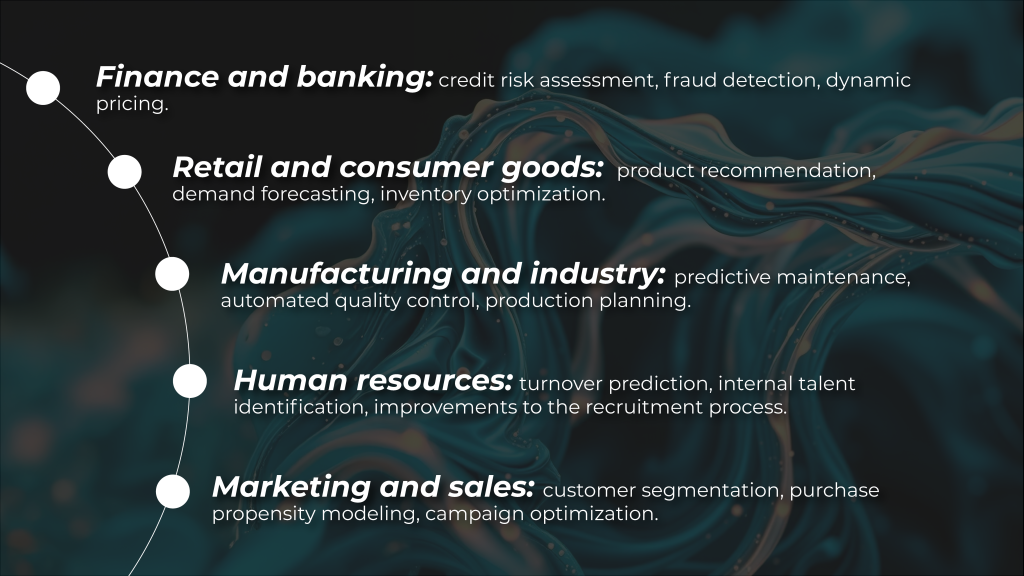
In all of these scenarios, the difference between a simple prediction and a strategic decision lies in explainability:knowing why the model produces a certain output enables teams to act with sound judgement and confidence.
From theory to practice
In real projects, the difference between a useful model and a transformative one lies in its ability to explain itself.
One example comes from an industrial company we worked with. Their initial goal was straightforward: predict whether a manufactured part would turn out defective. The model achieved this with remarkable accuracy. However, the operations team still couldn’t act effectively—they knew which parts were likely to fail, but not why.
This is where explainability became essential. By analyzing the factors that most influenced each prediction, we discovered that ambient humidity and small variations in machine temperature had a critical impact on defect formation.
With this information, the maintenance team adjusted thermal controls and redesigned part of the calibration process.
The outcome was twofold: a significant reduction in defective parts and a noticeable increase in the team’s confidence in the AI system.
What matters is not just predicting, but understanding—and that understanding turns an analytical tool into a true engine of continuous improvement.

We are living through a pivotal moment: the democratization of AI is bringing these technologies into every area of the business, from the executive committee to frontline operations teams. AI is no longer the exclusive domain of data scientists; today, any professional can interact with a model, question it, and make decisions based on its outputs.
In this new landscape, explainability becomes the foundation of responsible, ethical, and genuinely useful AI.Only by understanding how models work can we harness their potential without losing control—avoiding bias, ensuring transparency, and fostering more mature and sustainable adoption.

At Baobab, we believe that a model is only as good as the trust it inspires.This is why explainability isn’t an add-on at the end, but a pillar of our design approach.We prefer models that can explain their decisions, even if that means sacrificing a bit of accuracy, because we know they integrate better into processes, reduce risk, and generate real value for the organization.


