
In recent years, the pressure on efficiency in the Life Sciences sector has continued to grow. According to various industry studies, inefficiencies in planning, production, and inventory can account for up to 20–30% of total operating costs in pharmaceutical companies.
In this context, the difference is no longer just about producing more or selling more, but about making better decisions.
In environments involving expirations, GMP/GxP constraints, plant capacities, or commercial commitments, small operational decisions can have a direct impact on costs, service levels, or regulatory risk. However, as complexity increases, a structural limitation emerges: it is not possible to analyze all alternatives within the available time.
And this is where a key question arises for any decision-maker:
Are we making the best possible decision… or simply a valid one?

The challenge of decision-making in a complex Life Sciences environment
The pharma sector combines a very specific set of factors: high regulatory requirements, complex industrial operations, long planning cycles, and demand that can change abruptly. In this context, making decisions is not simply about choosing an option, but about finding a balance between competing variables such as service level, cost, regulatory risk, or the efficient use of production capacity.
Most organizations make decisions based on sound judgment and experience, which allows the system to function. However, as the number of variables grows—distributed inventories, batch sizes, GMP/GxP constraints, or capacity limitations—the decision space becomes unmanageable. Not due to a lack of knowledge, but because of human limits in processing complexity.
The result is a recurring pattern: correct decisions, but not necessarily optimal ones.
Valid decisions… but not necessarily optimal
Many companies have invested in business intelligence and advanced analytics tools to improve visibility into their operations. This has been an important step forward, but it has a clear limitation: understanding what is happening does not imply knowing what to do.
The real business impact emerges when organizations move from analyzing data to optimizing decision-making.
This is where artificial intelligence in decision-making, applied through mathematical optimization models, introduces a paradigm shift. Decision AI does not just describe or predict—it recommends the best possible decision while considering all business constraints.
This makes it possible to structure complex decisions such as demand and production planning, inventory management with expiration constraints, or capacity allocation across plants within a single model—something that is practically impossible to handle manually.
What Decision AI brings to the Life Sciences market
The impact of Decision AI is not theoretical, but operational and measurable. By introducing optimization models into decision-making, organizations can transform the way they plan and execute.
In real projects within the Life Sciences sector, this approach has demonstrated clear improvements across three key dimensions:

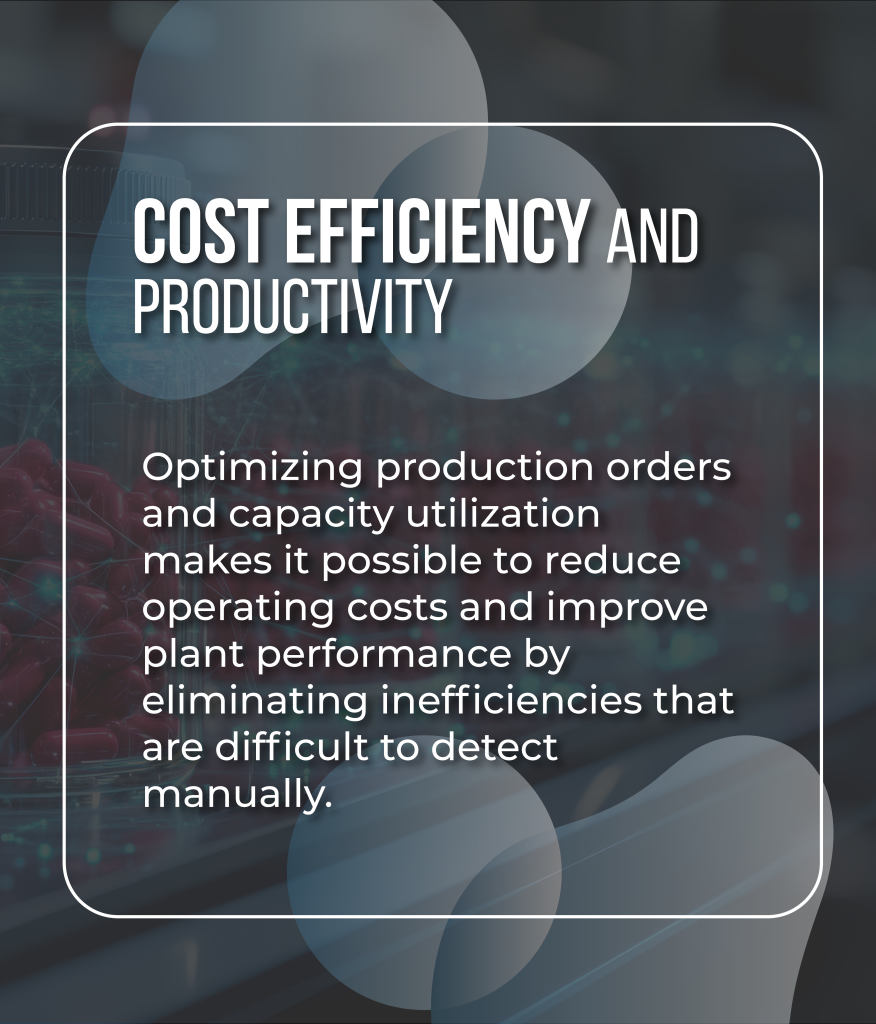
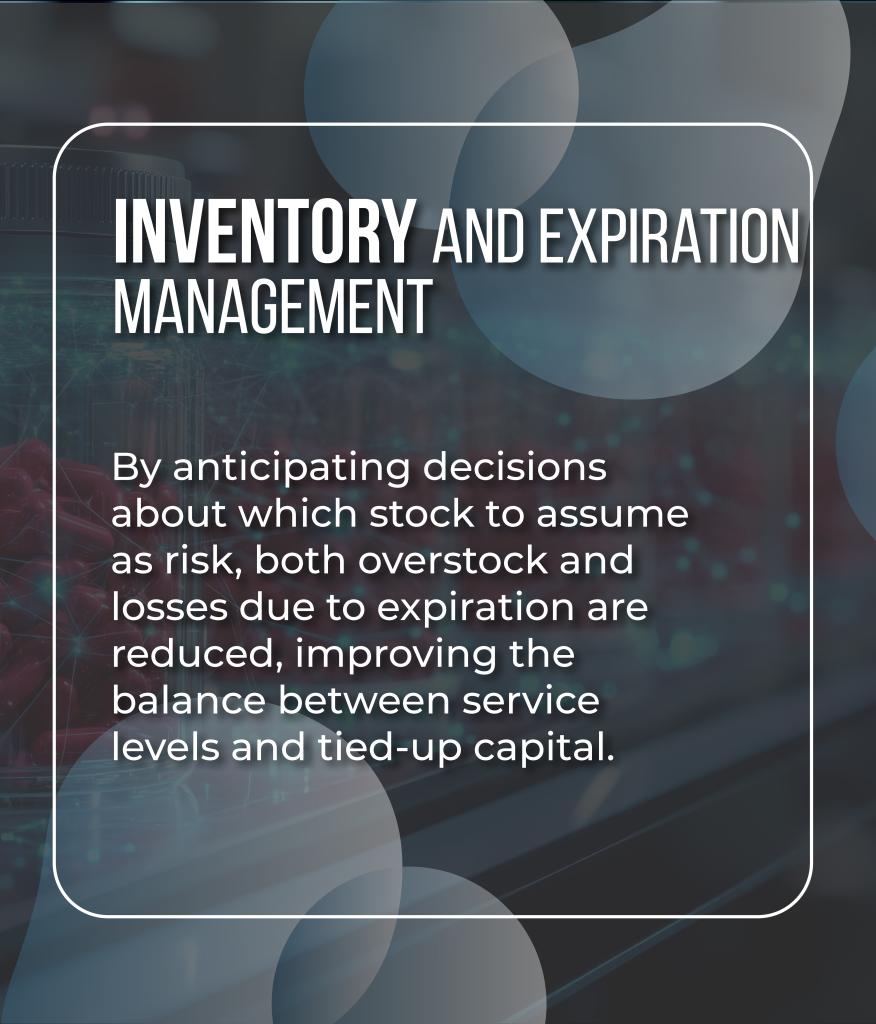
Beyond improvement percentages, the meaningful change is structural: decision-making becomes an optimized, repeatable process aligned with business objectives.
Operational efficiency without compromising compliance
One of the main challenges in Life Sciences is ensuring that any operational improvement respects the regulatory environment.
In this regard, Decision AI does not automate decisions but proposes optimal alternatives over which the decision-maker retains control. This makes it possible to preserve traceability, auditability, and required compliance while improving the optimization of industrial processes.
The result is more robust planning, with less reliance on urgent decisions and greater operational stability.
Fewer emergencies, more anticipation
The ability to simulate scenarios is another key element. Before executing a decision, it is possible to evaluate multiple combinations and understand the impact of changes in demand, production capacity, or commercial priorities.
This makes it possible to move away from defensive planning models and evolve toward more proactive management, where decisions are made with more information and less uncertainty. In an environment where mistakes carry a high cost, this anticipation translates into greater stability and confidence in the system.

Human decisions enhanced by models
Decision AI does not replace expert knowledge or the accumulated experience within organizations. On the contrary, it complements them.
It provides decision-makers with an expanded view of the decision space, allowing them to evaluate alternatives that would otherwise be unmanageable. This improves not only the quality of decisions but also alignment across teams and operational consistency.
The result is stronger decision-making, with a direct impact on efficiency and the bottom line.
Efficiency starts with the decision
In a sector where every decision has operational, regulatory, and economic implications, competitive advantage no longer lies solely in having more information, but in making better decisions with it. This AI-based technology makes it possible to transform valid decisions into optimal ones, reducing complexity and improving the ability to anticipate.
Because in Life Sciences, efficiency does not come from reacting faster, but from choosing better—and faster. If you are making complex decisions with incomplete information or under pressure, it is time to incorporate models that allow you to optimize them
Do you want to learn how Decision AI can optimize your decisions?