
Green hydrogen has become a major focus of the energy debate. Governments, industrial companies and energy producers are exploring its potential to replace fossil fuels in hard-to-electrify activities, from certain chemical processes to fertiliser production, refining and other energy-intensive industrial applications.
However, the growing interest in this technology coexists with a less visible reality: many announced projects never reach a final investment decision. The International Energy Agency has recorded more than 200 committed investments in low-emissions hydrogen projects, but warns that growth remains below initial expectations. The main barriers include cost, uncertainty around demand, regulation and the availability of infrastructure.
The real challenge is determining where, for whom, with which assets and under what conditions hydrogen can become a viable investment.
Hydrogen’s potential does not automatically make a project viable
Green hydrogen may offer significant strategic value, but turning that potential into an economically viable project remains difficult.
A production plant requires renewable electricity, water, an electrolyser, auxiliary systems, storage and, in many cases, infrastructure to transport or transform the hydrogen. It also needs a buyer willing to commit to price, volume and contract terms that are sufficient to support the investment.
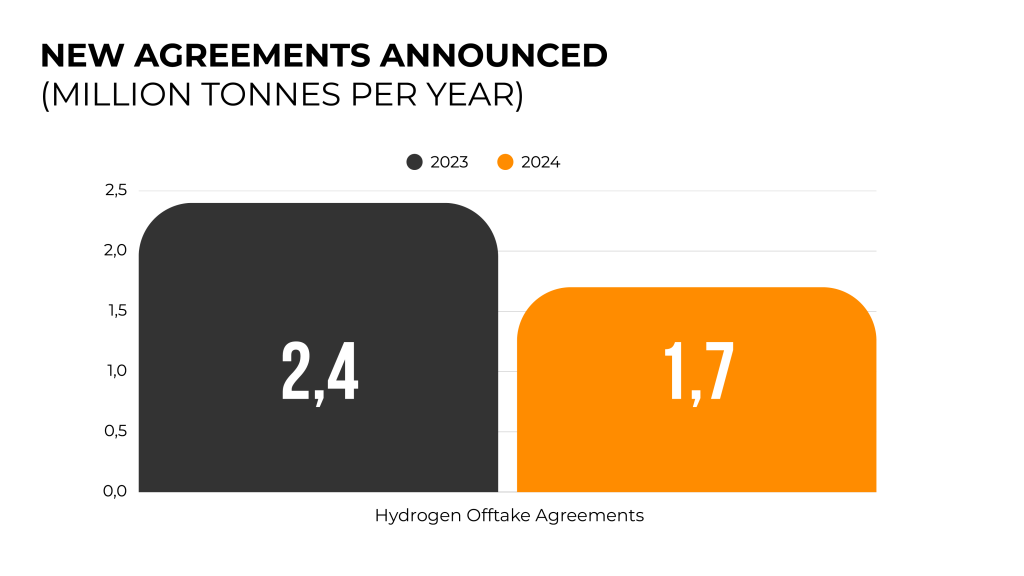
According to the International Energy Agency, low-emissions hydrogen offtake agreements lost momentum in 2024. Newly announced agreements fell from 2.4 million tonnes per year in 2023 to 1.7 million tonnes in 2024. A large proportion of firm commitments also remains concentrated in existing applications, such as refining and the chemical industry.
The first question should therefore be: what demand will the project serve, and under what conditions?
The answer directly affects the size of the electrolyser, the required storage capacity, the need for a grid connection and the delivered cost of the hydrogen, among other factors.
A cost forecast is not an investment decision
The levelised cost of hydrogen, or LCOH, estimates the average cost of producing one kilogram of hydrogen over the lifetime of a project. It normally takes into account capital expenditure, financing, electricity, operations, maintenance, component replacements and expected production.
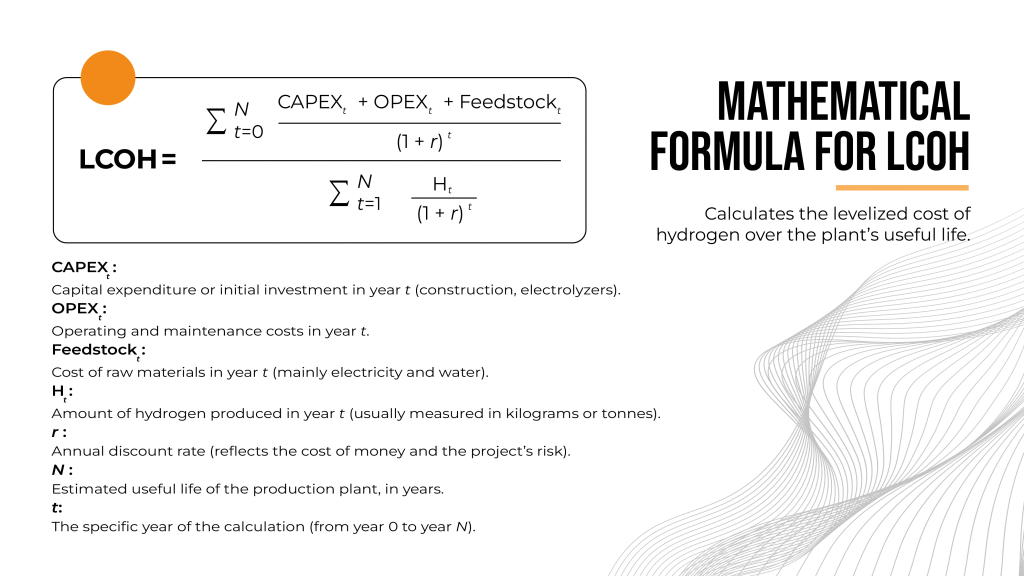
Although LCOH is an essential metric, it can create a false sense of precision.
The result depends on assumptions about electricity prices, renewable generation, electrolyser efficiency, the cost of capital and operating hours. A change in any of these variables can significantly alter the expected cost.
In addition, two project designs with a similar LCOH may have very different risk profiles. This is why an investment decision should not be based solely on the project’s estimated LCOH. It should also address questions such as:
- Which assumptions explain the result?
- What happens if electricity prices change?
- How much capital will remain underused?
- Can demand still be met during periods of low renewable generation?
- Does the project remain competitive under less favourable scenarios?
- Which configuration offers the best balance between cost, risk and flexibility?
Predictive analytics provides a foundation based on realistic operating scenarios
A green hydrogen plant depends on variables that change over time. Solar and wind generation fluctuate, electricity prices vary, and demand may deviate from initial contractual forecasts. Equipment efficiency also evolves, while certain components gradually degrade throughout the life of the project.
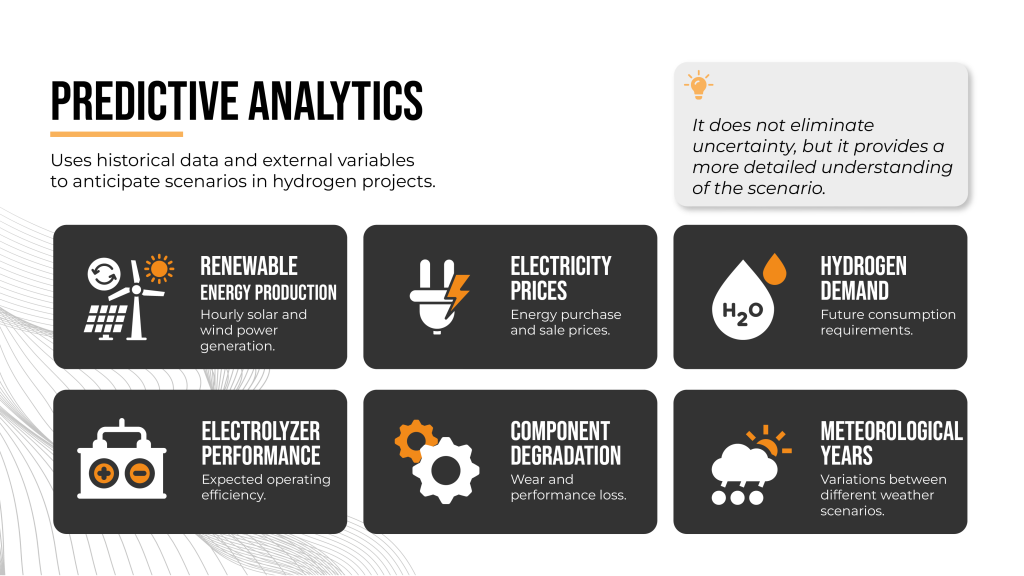
Predictive analytics uses historical data and external variables to estimate how these factors may behave in the future. It does not eliminate uncertainty, but it provides a more detailed understanding of the possible scenarios.
In a hydrogen project, predictive analytics can be used to forecast:
Potential variations between different meteorological years
Hourly solar and wind power generation
Electricity purchase and sale prices
Hydrogen demand
Electrolyser performance
Component degradation
Several studies apply machine-learning models to forecast electrolyser production and behaviour based on operating conditions. These capabilities make it possible to create more accurate representations of the system and assess how it could respond under different circumstances.
However, forecasting generation or demand does not determine how much capacity should be installed. Nor does it establish when hydrogen should be produced, how much should be stored or how much electricity should be purchased from the grid.
Operations research turns scenarios into decisions
Operations research makes it possible to represent a project mathematically through objectives, variables and constraints.
For a hydrogen plant, design variables may include:
- Solar and wind generation capacity
- Electrolyser capacity
- Hydrogen storage
- Battery capacity
- Grid connection capacity
Operational variables determine when each asset operates, how much electricity is used, how much hydrogen is produced and how demand is met.
The model also incorporates the project’s real-world constraints, including renewable availability, maximum capacities, efficiency, minimum electrolyser load, storage losses, contractual requirements, grid-connection limits, delivery obligations and regulatory rules.
Using this representation, advanced analytics can compare alternatives and recommend the decision that best supports the business objective. That objective may be to minimise total costs, reduce LCOH, maximise net present value or find the right balance between profitability, emissions and security of supply.
A study published in Renewable Energy developed a mixed-integer linear programming model, or MILP, to jointly optimise solar and wind generation, electrolysers, batteries and hydrogen storage across different European locations.
The analysis found that the optimal configuration depends on the renewable generation profile. It also showed that hybrid systems can improve asset utilisation and reduce costs compared with configurations based on a single energy source.
The value of the model lies in identifying when that combination is worthwhile—and when it is not.
From algorithms to decision-making
Decision AI combines different artificial intelligence technologies, including predictive analytics and optimisation, to assess a project and recommend the best possible, or optimal solution to the person responsible for making a complex decision.
In this context, it allows a green hydrogen project to be treated as an interconnected system in which every decision affects the others.
Demand, location, installed capacity, storage and operations can be analysed jointly to determine which configuration delivers the best results and which variables account for the greatest level of risk.
This approach provides a stronger foundation for deciding:
- Whether and when to move forward with a project
- How each asset should be sized
- Under which economic conditions the investment is viable
- How the project would respond to changes in prices, renewable availability or supply commitments
Explore our energy guide and discover how Decision AI can support planning and operational decisions.
References
International Energy Agency. (2025). Global Hydrogen Review 2025.
Marocco, P., Gandiglio, M., & Santarelli, M. (2026). Optimising green hydrogen production across Europe: How renewable energy sources shape plant design and costs. Renewable Energy, 256, 124542.
Marocco, P., Gandiglio, M., & Santarelli, M. (2024). Optimal design of PV-based grid-connected hydrogen production systems. Journal of Cleaner Production, 434, 140007.
European Commission. (2023). Renewable hydrogen production: New rules formally adopted.


