

Managing a supply chain involves coordinating information that changes continuously: orders, inventory, transport incidents, suppliers, documentation, deliveries, and forecasts. A significant part of the daily workload consists of consulting systems, gathering data, checking conditions, and transferring information between teams before action can be taken.
This workload increases as operations grow. An incident may require checking several sources, locating documentation, informing different people, and completing administrative tasks before reaching a response. The result is often more time spent coordinating the process and less capacity to deal with exceptions that genuinely require human judgment.
AI agents in the supply chain offer a way to automate part of this work. Their main role is to execute and coordinate tasks within a defined workflow, using the information and tools they have access to while maintaining supervision whenever the process requires it.
What is an AI agent applied to supply chain?
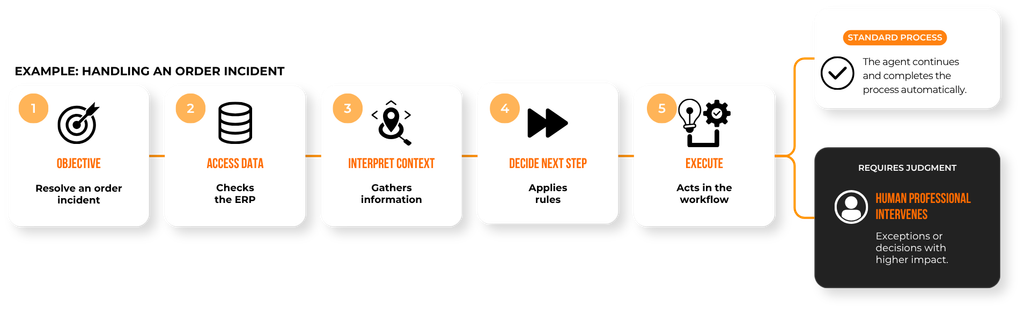
An AI agent is a system designed to receive an objective and carry out a sequence of actions to achieve it. It can retrieve information, interpret documents, perform calculations, use applications, generate responses, and continue to the next step in the workflow according to predefined rules.
This capability is particularly useful in processes where a person repeats the same sequence of queries and tasks every day.
Consider an issue involving an order. Managing it may require checking its status in the ERP, reviewing the expected delivery date, consulting previous communications, identifying the person responsible, preparing a response, and recording the action taken. An agent can handle a large part of this sequence, leaving the professional to intervene in situations where an exception needs to be assessed or a higher-impact decision needs to be made.
The opportunity therefore lies in processes with a clear objective, relatively structured tasks, and sufficient access to the information needed to execute them.
Where can AI agents add value in the supply chain?
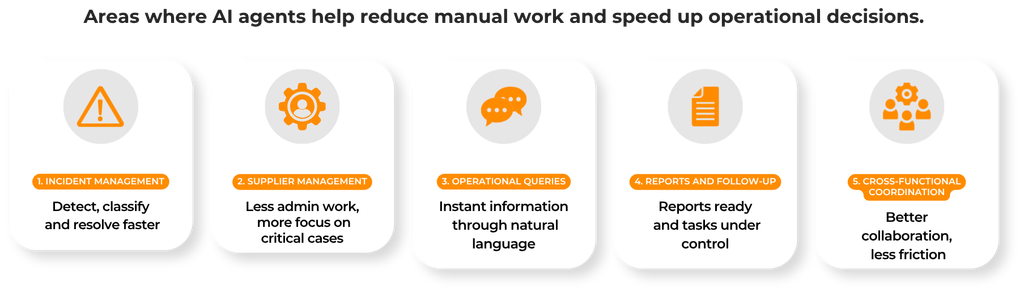
One of the clearest areas is incident management. A supply chain continuously generates exceptions: delayed deliveries, incomplete orders, pending documentation, date changes, or supplier issues. Classifying these situations, locating the relevant information, and directing each case to the appropriate team can consume a considerable amount of time.
They also have potential in supplier management. An agent can help gather documentation, consult agreed conditions, review available information, and prepare follow-up activities for specific tasks. When there are hundreds of suppliers and thousands of interactions, reducing this administrative work allows teams to focus their efforts on cases that require negotiation or professional judgment.
Another relevant scenario is operational information retrieval. Warehouse, transport, and planning managers constantly need answers about orders, inventory, deliveries, or incidents. An agent connected to internal sources can make that information accessible through natural language and reduce the time spent searching for it manually.
Report preparation, task follow-up, and coordination between departments offer similar applications. In these processes, the benefit generally comes from reducing manual steps, accelerating response times, and making execution more consistent.
Autonomy must be designed around the process
The key question when implementing an agent is which actions it can perform and which ones should remain subject to validation.
Checking the status of an order carries a relatively low level of risk. Modifying a purchase order, committing to a delivery date, or making changes with financial implications requires a different level of control. The architecture must reflect these differences.
It is therefore necessary to define from the outset which systems the agent can access, which actions it is authorized to perform, what information it needs, how its actions are recorded, and in which situations it must escalate the case to a person.
Human supervision becomes especially important when exceptions arise, information is incomplete, or decisions have significant consequences. Business judgment remains part of the process and makes it possible to validate, adjust, or stop an action whenever the context requires it.
What does a company need to apply AI agents that deliver real value?
The starting point is the process itself. Companies should identify repetitive tasks that consume time, follow a recognizable sequence, and depend on information available within the organization’s systems.
From there, data quality and integrations determine the outcome. An agent that needs to check orders, inventory, or deliveries requires reliable access to those sources. It also needs clearly defined permissions and rules governing what it is allowed to do.
The final element is measurement. Time saved, reduction in manual tasks, response speed, number of incidents handled, or percentage of cases escalated are some of the indicators that can be used to assess whether the agent is genuinely improving the process.
This approach is particularly well suited to supply chain environments, where strategic, tactical, and operational decisions coexist and where there is a high coordination workload across procurement, production, warehousing, and distribution.
AI agents for a more agile supply chain
AI agents make it possible to further automate tasks surrounding day-to-day operations: retrieving information, managing incidents, working with documentation, carrying out follow-ups, and coordinating workflows.
Their value depends on selecting the right process, establishing clear boundaries for action, and connecting them to reliable information. In supply chain, this capability can reduce administrative workload and enable faster responses in an operation where new exceptions arise continuously.
At Baobab AI, AI agents are part of the capabilities within Decision AI, alongside other technologies applied according to the question each process needs to resolve.
If you would like to explore how we apply Decision AI to the supply chain, discover Baobab SupplyOps, our approach to planning, procurement, warehousing, inventory, transport, and logistics network design decisions from an End-to-End perspective.


