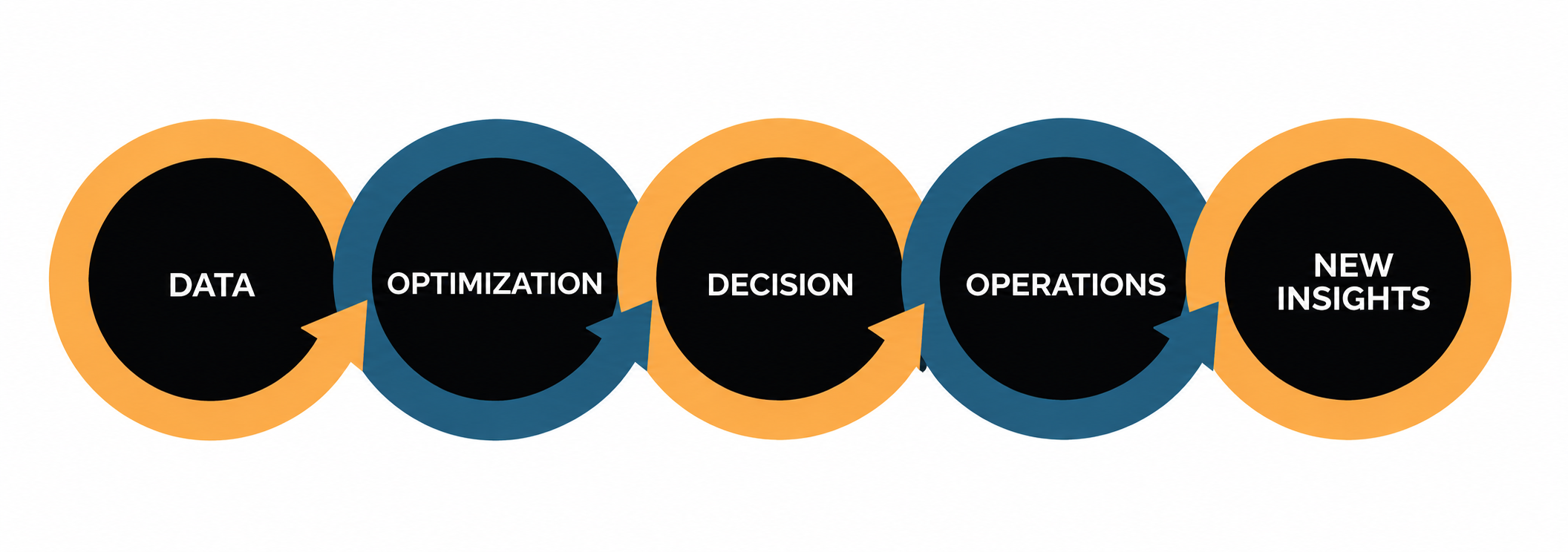
What is the best way to transport a product between two points?
At first glance, the answer may seem simple. In logistics network optimization, it rarely is.
Which vehicle should be used? When should it depart? Can the trip be used to transport other products? Will there be space available at the loading dock when it arrives? Where will that vehicle be needed next? Will there be enough stock until the next shipment?
Each of these questions introduces new variables and constraints. When they interact, finding a feasible plan can be relatively straightforward. The challenge lies in identifying a solution that optimizes resource utilization, costs, and service levels.
A logistics network is linked to a chain of decisions
Transporting a product from point A to point B is only one part of logistics network optimization. Planning a distribution network requires coordinating multiple decisions: what and how much to transport, when to transport it, which vehicle to use, which route to follow, and which resources to allocate.
All these decisions are interconnected. If I choose a larger vehicle for a route, I may be able to collect products from two suppliers instead of one, but this may also increase transportation time and costs. If I assign a specific truck to a transport operation, I could affect loading and unloading dock capacity at each location, as well as the stock levels available at each one after the operation.
Each decision affects the options available in subsequent stages of the planning process. This interdependence is precisely one of the main challenges of logistics planning.
| Decision | Constraints affecting the decision | Constraints / resulting consequences |
| What to transport and when | Demand, orders, stock levels, delivery dates, product availability, loading and unloading windows, vehicle and driver availability, shifts, and stock requirements | Determines transportation needs, affects subsequent stock levels, and reduces the route and scheduling alternatives available for other operations |
| How much to transport in each transport operation | Available quantity, demand, vehicle capacity, weight, volume, and number of pallets or boxes | Determines the available space in the vehicle and may affect which other products or suppliers can be included in the same transport operation |
| Which vehicle to use | Capacity, vehicle type, availability, cargo weight and volume, hazardous materials, regulations, national requirements, traffic restrictions, type of goods, and vehicle characteristics | Determines which loads can be transported and when the vehicle will become available for other transport operations |
| Which suppliers to group on a route | Supplier locations, quantities, time windows, vehicle capacity, and loading times | Increases the number of stops and may limit the amount of product that can be collected later |
| Which resources to use in each operation | Availability of vehicles, drivers, docks, warehouses, and other operational resources | Using a resource in one operation may prevent or delay its use in another |
| Replanning in response to an incident | Delays, vehicle or facility unavailability, changes in demand, or changes in stock levels | Changes decisions already made and may require vehicles, routes, schedules, and loads to be reassigned |
| Maintaining stock levels | Demand, transportation times, storage capacity, product availability, and transportation frequency | Determines when and how much should be transported later |
The problem becomes more complex when constraints interact with one another. A vehicle may have sufficient capacity to transport a particular load but may not be available when needed. Another vehicle may be available but not authorized to operate in certain countries. Even if a vehicle is compatible with the route and available at the right time, assigning it to that transport operation may prevent it from being used in subsequent operations.
As a result, a decision that may not appear to be the best option for a specific route can have a positive impact on the overall plan. Likewise, a decision that seems appropriate for a particular route may ultimately reduce the efficiency of the entire network.
Should we continue planning manually?
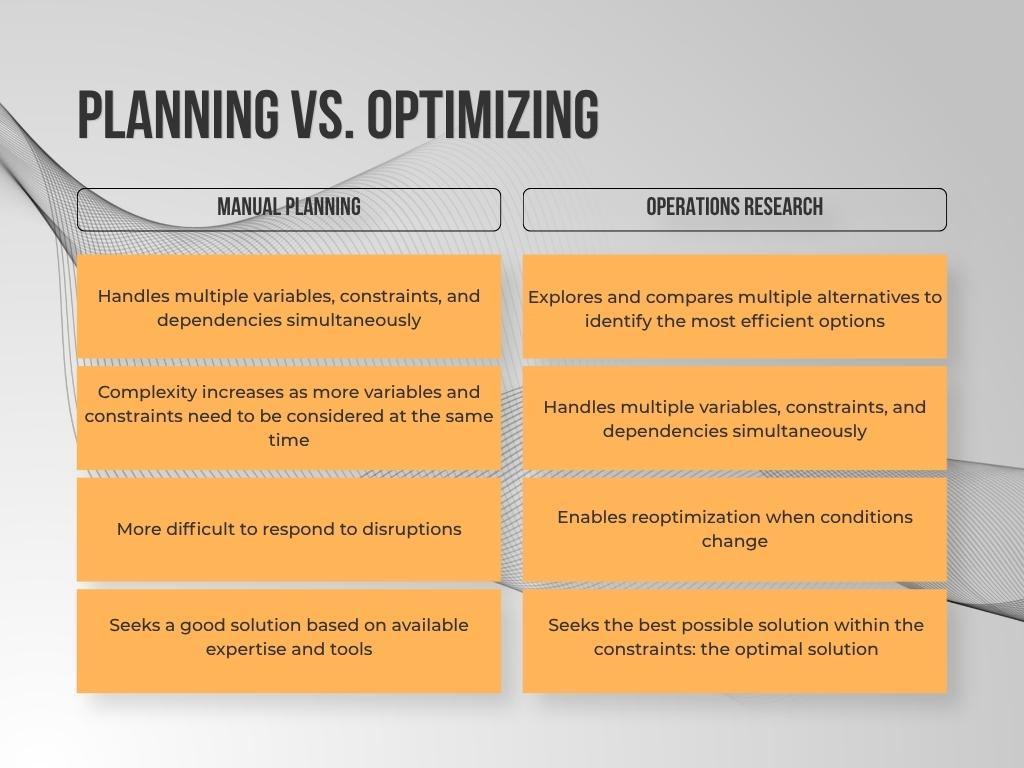
In many companies, manual planning of distribution networks remains common practice. However, finding a feasible solution that efficiently optimizes logistics networks from an overall perspective can be highly complex.
Even with only a few routes, vehicles, and products, there are already many possibilities. As the network grows, the number of possible solutions increases exponentially. Evaluating a large number of combinations requires time that is not always available, and a seemingly optimal solution may fail to meet critical constraints.
Once an initial plan has been defined, a second challenge arises: adapting it to unexpected events. For example, a vehicle breaks down, a supplier delays a delivery, demand changes, a warehouse becomes unavailable, a driver calls in sick… All these situations may require an ongoing plan to be modified quickly, which can be particularly complex when resources are limited. Remaining competitive requires tools that enable organizations to respond to change with agility and efficiency.
The consequences of poor planning or a delayed response are not only financial. In addition to higher costs, inefficient planning can lead to congestion, delays, missed delivery windows, stockouts, or employee overtime.
Optimizing a logistics network means finding the right balance between costs, service quality, resource utilization, and operational constraints. In practice, balancing all these factors manually is becoming increasingly complex. This makes it necessary to move from manual analysis to methods capable of exploring and optimizing multiple alternatives.
From planning to optimization: the role of operations research
This is where operations research comes into play. In Logistics Network Optimization, operations research uses mathematical models and optimization methods to support complex decision-making. These models can simultaneously analyze vehicles, products, employees, schedules, capacities, and other constraints, making it possible to explore far more alternatives than could be evaluated manually.
Problems involving logistics networks have been extensively studied, leading to different strategies for efficiently exploring a large number of possible plans. Some of the most widely used methods include:
- Heuristic methods: These aim to find high-quality solutions within a reasonable amount of time, without guaranteeing that the solution found is the best possible one. They are particularly useful when the number of possible solutions is very large and a solution must be obtained quickly.
- Exact methods: These aim to find the optimal solution to the problem—that is, the best possible solution according to the defined KPIs and constraints. They systematically explore possible solutions, although the time required to solve the problem may increase as its complexity grows.
In both cases, the objective is the same: to identify, among all possible alternatives, those that enable better decisions. The choice of method depends primarily on the characteristics and constraints of the problem and on the KPIs involved in logistics network optimization.
Compared with manual planning, operations research makes it possible to explore a greater number of alternatives and evaluate them according to defined constraints and objectives. As a result, it is possible to find higher-quality solutions for problems whose complexity makes an exhaustive analysis of all available options difficult. In addition, when an unexpected event occurs, the models can solve the problem again and quickly generate alternative solutions.
From Optimization to Decision AI
Optimizing logistics network planning is only one part of the decision-making process.
To integrate this capability into operations, optimization models need to connect with the data and systems that reflect the current state of the network, including orders, inventory levels, vehicle availability, schedules, disruptions, capacity, and demand. At the same time, certain stages of the process need to be automated while enabling planners to monitor, understand, and interact with the solutions generated.
This is where Decision AI comes into play: an approach for building systems that support complex decision-making by leveraging available data sources and combining operations research, system integrations, and automation. Beyond optimization, Decision AI provides flexibility, agility, traceability, and full control over the decision-making process.