

In the energy sector, weather has never been just a background detail — it’s a decisive factor that shapes production, distribution, and profitability. In recent years, this connection has grown increasingly complex and demanding.
The variability driven by climate change — from heatwaves and intense storms to unusual wind patterns and extreme rainfall — impacts far more than daily operations. It also challenges the medium- and long-term forecasts that underpin investments, contracts, and energy policies.
Today, renewable energy plays an increasingly prominent role in the grid. According to the Bank of Spain, wind and solar generation have grown by more than 14% since 2019. This means that any gap between forecasted and actual output has a direct impact on supply stability and system costs. In practice, an inaccurate forecast can force operators to buy power at high prices on the spot market or waste surplus energy due to poor planning.
In this context, weather forecasting becomes a strategic lever. This is where AI-powered prediction and simulation models come into play, offering the ability to detect climatic variations with high precision — and anticipate their impact before they disrupt operations.
How does it work?
AI predictive models

Instead of directly solving all the physical equations, machine learning models detect patterns in vast datasets — both historical and real-time — and uncover complex correlations through neural networks. This approach enables faster processing, lower resource consumption, and improved resolution and accuracy in forecasts.
It opens the door to new possibilities, from highly accurate daily forecasts to climate projections spanning decades. Recent examples highlight its potential:
- GraphCast (DeepMind) delivers 10-day global forecasts more accurately than traditional systems — in under a minute.
- NeuralGCM (Google Research) blends physics with AI, improving medium-term predictions while reducing the cost of climate simulations by a factor of 100,000.
- ClimaX (UCLA and Microsoft) adapts to different variables and scales, outperforming other AI models in standard tests while consuming fewer resources.
Climate digital twins
Artificial intelligence is also driving the development of climate digital twins — virtual replicas of Earth capable of simulating, in remarkable detail and near real time, how the climate system will behave under different scenarios.
This technology blends advanced physical models with AI algorithms and live data from satellites, weather stations, and sensors. The result is a powerful tool for anticipating extreme events, assessing risks, and planning adaptation strategies for both businesses and public institutions.
What benefits does the energy sector gain from implementing AI systems to anticipate climate changes?
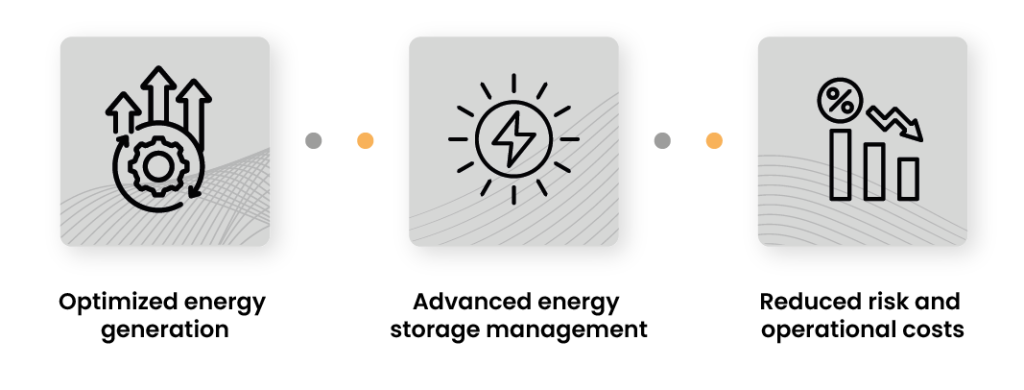
- Optimized energy generation: fine-tune wind, solar, or hydroelectric output to make the most of peak generation periods.
- Advanced energy storage management: plan battery charging and discharging — or other storage systems — based on generation and demand forecasts.
- Reduced risk and operational costs: limit exposure to price fluctuations in the electricity market and mitigate the impact of extreme weather events on infrastructure.
In an increasingly competitive energy landscape — and one that will likely be shaped ever more by climate variability — the ability to anticipate events and simulate scenarios is becoming a defining factor for the efficiency and resilience of power plants.
AI-powered predictive models and digital twin solutions are narrowing the gap between what we can forecast today and what we need to know to make better decisions.
The question is no longer whether these tools will be integrated into energy management, but rather who will be first to leverage them to turn volatility into a strategic advantage.


