
The profitability of a battery depends both on its technical characteristics and on the decisions that determine how it is used.
An energy storage system can charge when prices are low and discharge when they rise. It can also participate in balancing markets, provide certain grid services, or make better use of the output from a renewable energy facility.
All these opportunities rely on the same asset and compete for limited capacity. Reserving energy or power for one of them affects the alternatives available over the following hours.
Value Stacking consists of coordinating these sources of value to determine the most advantageous use of the battery at any given time and throughout the project’s lifetime.
Sources of value for an energy storage system
A BESS (Battery Energy Storage System) is a battery-based energy storage system capable of charging electricity, storing it, and subsequently delivering it back to the grid or to a facility.
Its flexibility makes it possible to shift energy over time. This capability opens up different avenues for value generation: energy arbitrage, balancing markets, reserves, grid services, or renewable generation integration, among other possibilities subject to the rules of each market.
Value Stacking manages these opportunities within a common strategy.
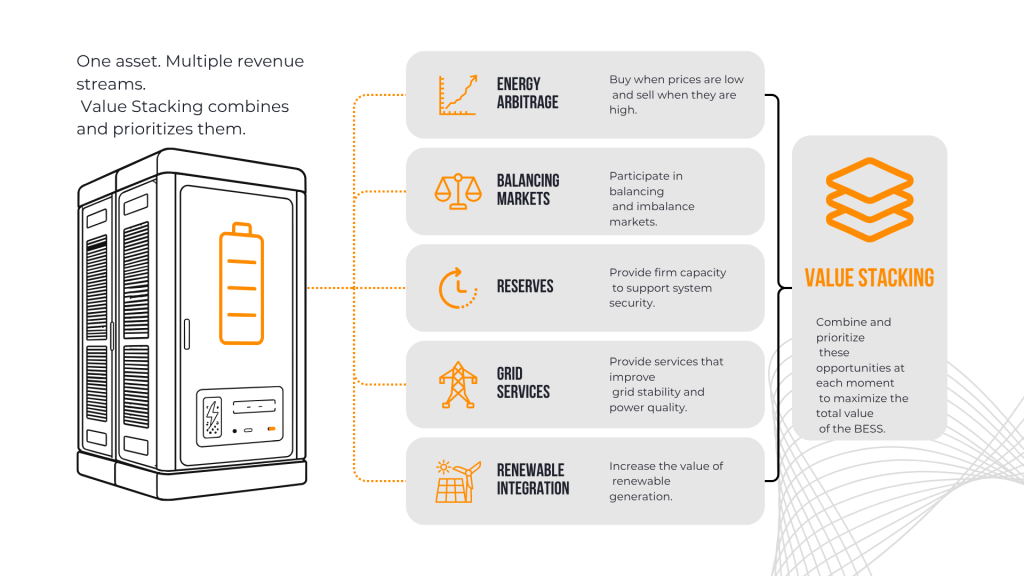
IRENA incorporates this logic into its Electricity Storage Valuation Framework. Its methodology identifies the services that storage can provide, assesses their value, simulates operation and revenue stacking, and subsequently examines the project’s economic viability.
The key issue for the asset owner arises when several opportunities coincide. The battery has a limited amount of stored energy and power. Using these resources to capture one source of revenue changes the options available later.
A single battery can have several economic uses, and the way they are combined affects the return on investment.
Profitability depends on how opportunities are allocated
Imagine a battery that is fully charged in the early afternoon.
Forecasts point to high prices later in the day. Keeping the energy stored would make it possible to capture that price spread. During those same hours, an attractive opportunity may arise in a balancing market, where participation requires reserving part of the battery’s power capacity or maintaining a specific state of charge.
Every decision changes the alternatives available later.
This is why Value Stacking turns battery operation into an allocation problem: what share of the available capacity should be assigned to each opportunity, and at what time.
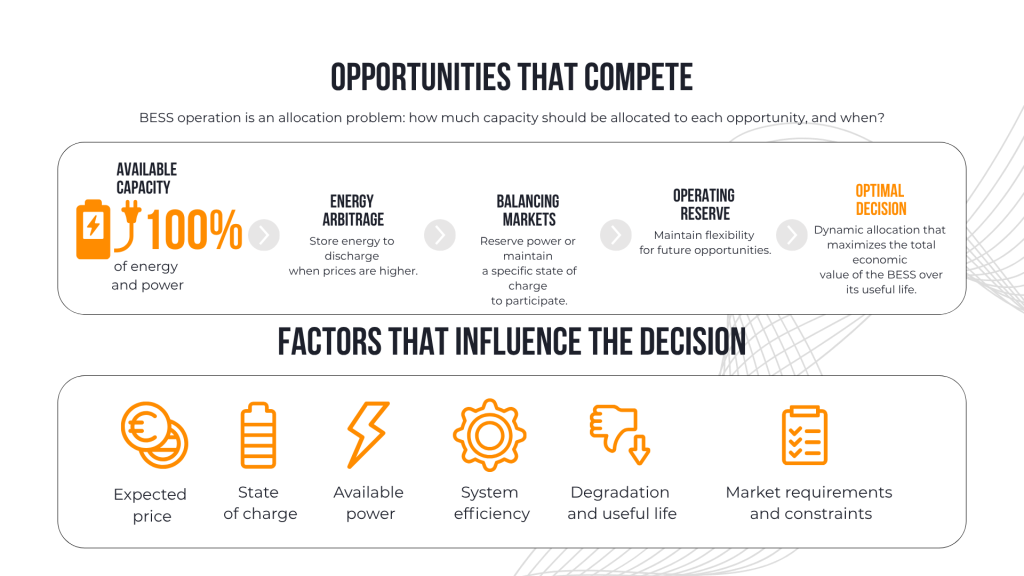
Expected price is one part of that decision. Other factors also come into play, including state of charge, available power, system efficiency, the requirements associated with each service, and the asset’s operating conditions.
Degradation adds a particularly important variable. More intensive use may increase short-term revenues while simultaneously accelerating battery wear. This affects its future capacity, useful life, and the manufacturer’s warranty conditions.
The study published in Energy & Environmental Science in 2026 analyzes this interaction between storage, access to different markets, efficiency, and degradation. Its findings show that profitability is strongly shaped by the actual opportunities for market participation and by the asset’s operating constraints.
The business objective is to maximize the total economic value of the BESS over its useful life. This requires considering current revenues, the cost associated with using the battery, and the asset’s future ability to continue generating value together.
Market and Grid Access as Factors Affecting the Economic Viability of a BESS
A battery that is technically capable of providing several services may still face limitations in how it can be operated.
The grid connection point determines how much power can be exchanged with the grid. In hybrid projects, renewable generation and storage may share this capacity. In addition, permits, technical requirements, and regulatory conditions determine which markets are actually accessible to the asset.
IRENA specifically distinguishes between the value that storage can provide to the power system and the revenues that the owner is able to monetize. This difference can have a direct impact on the project’s economic viability.
For this reason, before committing CAPEX, it is advisable to jointly assess:
- which markets the BESS can actually access;
- what constraints are introduced by the grid connection point;
- which services can be combined;
- how degradation affects operation;
- what happens if the remuneration of one of the revenue streams changes.
This last issue becomes particularly important when a large share of the business case depends on a single market. Prices, competition, or regulation may evolve over the asset’s operating life.
Value Stacking makes it possible to assess a broader portfolio of opportunities and determine which combination offers the best balance between expected return, asset utilization, and risk.

From an investment hypothesis to an ongoing decision-making process
The economic model defines how a battery could generate value. Daily operation determines how much of that value is ultimately captured.
Prices change constantly. Renewable generation, state of charge, asset availability, and the opportunities offered by each market also evolve. A strategy defined during the investment phase must adapt to this new information throughout the operating phase.
This is where the analytical capabilities that support Value Stacking come into play.
Forecasts help anticipate prices, demand, or renewable generation. Based on this information, optimization models can compare charging, discharging, and capacity-reservation alternatives while respecting the BESS constraints.
To do so, the model must represent variables such as state of charge, maximum power, efficiency, operating limits, and the requirements for participating in different markets. The economic objective then determines which combination of decisions is most advantageous.
Simulation complements this analysis by making it possible to evaluate how the strategy would respond under different price, utilization, or market-condition scenarios.
The Imperial College paper develops precisely an optimization approach for coordinating storage operation under different configurations and market-access possibilities.
All this technical capability must translate into a specific recommendation on how to use the available flexibility to achieve the best expected outcome.
This decision can be implemented directly by the asset owner or supported by a specialized aggregator or optimizer. In both cases, it is advisable to define what information feeds into the decision, which constraints must be respected, and how the strategy is updated as the market changes.
Capturing the value of flexibility
The profitability of a BESS is built over its entire useful life. Value Stacking makes it possible to use its flexibility more effectively by deciding how to allocate limited capacity among opportunities that change according to the market, the asset’s condition, and its operating constraints. Therefore, the ability to anticipate scenarios and choose each use based on economic criteria is critical to capturing the potential value of energy storage.
If you would like to learn more about the key aspects of batteries and energy storage, request our specialized guide.

References
IRENA. (2020). Electricity Storage Valuation Framework: Assessing system value and ensuring project viability. International Renewable Energy Agency, Abu Dhabi.
https://www.irena.org/-/media/Files/IRENA/Agency/Publication/2020/Mar/IRENA_storage_valuation_2020.pdf
Landy, M., Schmidt, O., Johnson, N., & Staffell, I. (2026). Maximising the economic value of renewable and battery storage hybrids with revenue stacking. Energy & Environmental Science, 19, 4469–4494.
https://pubs.rsc.org/en/Content/ArticleLanding/2026/EE/D6EE00776G
UNDP. (2026). Unlocking the Potential of Distributed Generation through Net Metering & Net Billing in Arab States. United Nations Development Programme.
https://www.undp.org/lebanon/publications/policy-brief-unlocking-potential-distributed-generation-through-net-metering-net-billing-arab-states
Energy-Storage.News. (2026). Grid-forming, hybrids and alternative chemistries in Wood Mackenzie’s 2026 energy storage trend predictions.
https://www.energy-storage.news/grid-forming-hybrids-and-alternative-chemistries-in-wood-mackenzies-2026-energy-storage-trend-predictions/