

Artificial Intelligence (AI) has ceased to be a promise and has become the engine of modern efficiency. Today we find it everywhere: from recommendation systems that decide our next series, to virtual assistants that manage schedules or predictive models that anticipate failures in a supply chain.
However, despite its popularity, many AI projects fail. One of the main reasons they do not translate into results is that they are managed as if they were traditional software projects, when in reality they operate under completely different principles.
It is not about radically changing project methodologies, but rather paying attention to those aspects of these projects that make them unique compared to other traditional software projects.
Understanding this difference is key to avoiding mistakes, maximizing return on investment, and developing truly useful solutions.

The big difference: deterministic software vs. probabilistic systems
While traditional software follows fixed rules (“if A happens, then do B”), AI systems work with probabilities and estimates. They do not offer absolute certainty, but rather results with a certain level of confidence.
This implies that the same behavior cannot be guaranteed for the same input, something unthinkable in classical software.
In contrast, Artificial Intelligence projects do not work in that way. Instead of programming rules, we train models using data. These models learn patterns, generate predictions, and make decisions based on probabilities, not absolute certainty. We have percentages of confidence or reliability for the solution obtained.
For this reason, managing an AI project requires paying attention to new elements that must be incorporated into our project management methodology.
Data as the core of the project
If in traditional development code was the most important part of the system, in AI the main element is data. The quality, quantity, and representativeness of the data will directly determine the performance of the model in our project.
A large part of our effort will not be in programming, but in the following actions related to data: collecting relevant data, cleaning and refining information, labeling correctly, detecting biases, and keeping the data up to date.
A good model trained with bad data will produce bad results.
In many AI projects, more than 70% of the actual effort is dedicated to working with data, not with the model.

Discover real experiences about managing AI projects in our interview with Ignacio Zubizarreta, Project Director at Baobab AI.
Key elements in an Artificial Intelligence project
When managing an AI project, there are one or several fundamental components that allow us to recognize that we are working with an AI project. These elements must be analyzed from the beginning and included as a focus of attention within the project.
1. Personalization
One of the greatest values of AI is its ability to treat each user as a unique individual. Personalization makes it possible to deliver the right message to the right person at the right time.
A common mistake is to generalize too much, losing the true potential of AI.
For example, recommending products to all users is not the same as adapting the experience based on their behavior, history, or context.
2. Transformation of Unstructured Data
A large part of real-world information is unstructured: texts, images, audio, videos, emails, conversations…
AI makes it possible to transform this type of data into useful information through techniques such as natural language processing, computer vision, sentiment analysis, or automatic classification.
This step is often the most costly part of the project and, in many cases, the one that determines its real feasibility.
3. Conversational Solutions
Virtual assistants and chatbots are among the most visible use cases of AI. However, their implementation is not trivial.
A good conversational system must understand context, handle ambiguity, and learn from interactions.
It must also be able to manage errors, scale correctly, and always provide a smooth user experience.
Managing these solutions as simple question-and-answer flows often leads to frustrating user experiences.
4. Prediction and Decision Support
Another major contribution of AI is its predictive capability: anticipating behaviors, detecting risks, or suggesting optimal actions.
Here, AI does not replace humans but complements them. The real value lies in helping people make better decisions—faster and based on data.
AI does not replace human judgment; it enhances it.
5. Autonomous Systems
From autonomous vehicles to systems that optimize processes without human intervention, these types of solutions require especially careful management.
The level of risk is higher, and validation must be constant, since the system operates in real and changing environments.
In this type of system, validation, continuous monitoring, and control mechanisms are essential.
6. Pattern and Anomaly Recognition
AI particularly excels at detecting complex patterns and anomalies that would go unnoticed by a person.
Common mistakes in AI Projects
Across many failed projects, the same mistakes tend to recur. Identifying them early can make all the difference.
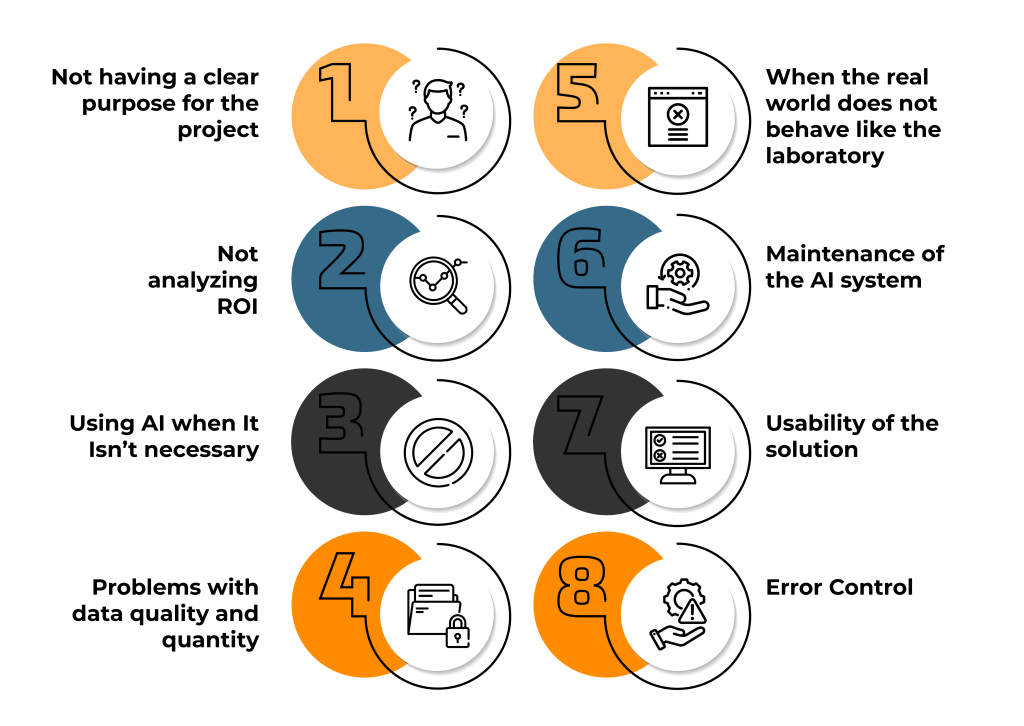
1. Not Having a Clear Purpose for the Project
We must ask ourselves this question at the beginning of the project: Why are we doing this AI project?
If there is no clear objective or real problem to solve, the initiative is doomed to fail.
AI should not be an end in itself, but a means to generate value.
2. Not Analyzing ROI
Implementing AI usually involves significant investment: data, infrastructure, specialized talent, development time…
Without a realistic estimate of the return, AI can become an expensive experiment with no real impact.
3. Using AI When It Isn’t Necessary
Not every problem requires Artificial Intelligence. Even when AI is used, it does not always require the newest or most innovative solution.
In many cases, traditional automation or a well-defined rule would be sufficient.
Confusing automation with AI is a very common mistake that creates unnecessary complexity.
4. Problems with Data Quality and Quantity
Data is the core of AI, and two common problems often appear here:
- Poor-quality data: poorly labeled, incomplete, or biased
- Too little data: insufficient for the model to learn properly
Both situations lead to unreliable models and inconsistent results.
5. When the Real World Does Not Behave Like the Laboratory
A system may work well in the lab but fail in production due to new variables that were not considered.
That is why it is essential to validate the system in real conditions as early as possible. This helps avoid surprises during deployment caused by not accounting for the final real environment.
6. Maintenance of the AI System
AI is not a project that is built once and then forgotten; it is a living system that degrades if it is not maintained.
Models degrade over time if the context changes and they are not retrained.
This means that from time to time we must retrain models, monitor results, and adjust parameters so the system continues to operate correctly within the defined parameters.
7. Usability of the Solution
The project you develop will be used by people—or at least intended to reduce their workload.
Designing a solution with poor usability will create resistance, even if it is technically correct.
Thinking about the end user is key to the success of the project.
8. Error Control
When AI fails, we must consider a human or automated alternative. Since this is a non-deterministic solution, there will always be a possible percentage of failure.
It is essential to have a plan B for these cases and to establish a clear procedure for handling them.
Managing Artificial Intelligence projects requires a change in mindset: accepting uncertainty, working with imperfect data, and prioritizing real business value.
AI projects are not deterministic, they are not perfect, and they do not offer absolute guarantees. But when they are managed correctly, they can generate extraordinary value.
When their particularities are understood and managed properly, AI projects stop being a trend and become a genuine competitive advantage for organizations.


