

In today’s industrial ecosystem, intuition and spreadsheets are no longer viable tools for ensuring business survival. In this context, the adoption of dynamic technologies that make up what we have been calling Industry 4.0 for years is becoming increasingly decisive.
The operational impact of these technologies is undeniable. On the one hand, during the design phase, technology and industrial giants such as Siemens have demonstrated in advanced facilities (such as their electronics plant in Amberg) that the use of these virtual replicas can reduce time-to-market by up to 50% and operating costs by up to 30%.
But beyond being the latest buzzword, where does this technology really come from, and how does it achieve such a significant impact on the bottom line?
What Is a digital twin in industry?
A digital twin is far more than a virtual representation of a physical asset; it is a dynamic data ecosystem that mirrors the operational status, interdependencies, and behavior of a machine, production line, or entire plant. Its true value lies in its ability to evolve alongside reality, becoming a simulation environment where scenarios can be analyzed, anticipated, and optimized without compromising the continuity of the physical asset.
It is not simply a static blueprint or diagram. A digital twin continuously receives data from sensors and operational systems, allowing its representation to evolve alongside the reality it mirrors.
The term “digital twin” was formally coined in 2002 by Dr. Michael Grieves at the University of Michigan. However, the practical essence of this technology has been in use for decades. NASA was already applying the concept during its space missions in the 1960s, building exact replicas on Earth to test, simulate, and correct the performance of spacecraft operating thousands of kilometers away.
Today, technological maturity has enabled this tool to evolve from a privilege reserved for aerospace agencies into one of the most powerful optimization engines in smart manufacturing. However, to fully understand its potential, we must dispel a common myth: a digital twin is not simply a 3D model connected to sensors.
If you’d like to explore more content like this
Sensors or parameters? How does this technology really work?
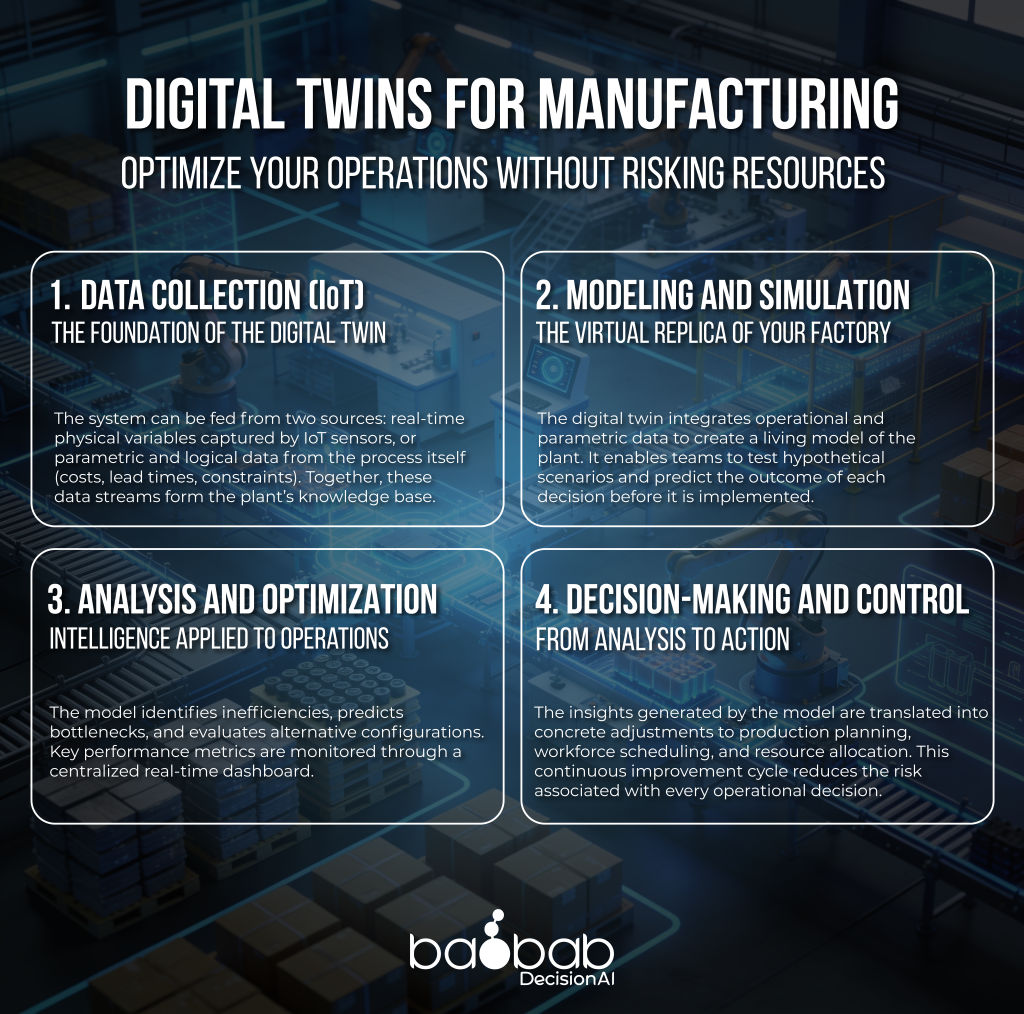
To understand how this technology operates, we must first discuss IoT sensors. These are physical devices connected to machines and industrial environments that capture real-time variables such as temperature, vibration, pressure, and energy consumption. Their role is essential in capturing the physical pulse of the plant, as they enable continuous asset health monitoring, immediate detection of operational anomalies, and the prevention of unplanned downtime. However, while they play a critical role in improving the accuracy of the model, they are not a mandatory large-scale requirement from the outset.
There is a widespread belief that without a large-scale IoT sensor network, there can be no digital twin. However, in smart manufacturing, strategic value often lies in operational and parametric data. While sensors tell us what is happening right now, parameters tell us how the business actually works. Integrating variables such as energy costs, cycle times, workforce capacity, and technical constraints enables the digital twin to function as an advanced simulation laboratory.
This is where DecisionAI transforms the model into a prescriptive tool. The objective is not merely to observe the plant on a screen but to leverage algorithms that support decision-making in complex scenarios. For example, when raw material prices change, the digital twin can recalculate the most profitable production and demand planning strategy, enabling efficient operations without costly trial-and-error experiments in the physical world.
When does the real paradigm shift happen?
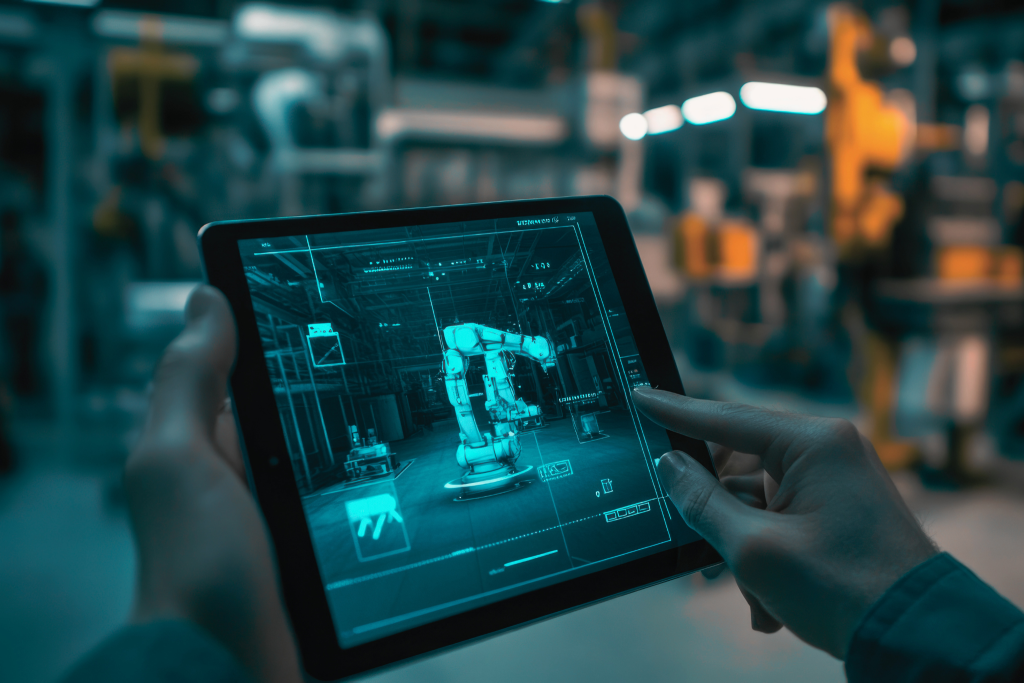
The fundamental difference between a simple virtual model and an advanced digital twin lies in its ability to continuously integrate live information and solve highly complex testing environments.
The real engine starts when the system processes critical operational information. Everything converges within the virtual environment to feed the models. From there, the algorithmic brain rigorously evaluates all operational constraints and simulates different future scenarios. Simulation provides management teams with the mathematical validation required to make decisions without relying on empirical risk.
How can companies start implementing digital twins?
Digitalization does not have to be overwhelming. The architecture of a modern digital twin can always be modular. Organizations can begin by modeling specific critical processes, such as inventory management or a particular assembly line, to achieve a rapid return on investment and encourage incremental adoption.
This modular approach allows the solution to scale organically, adding layers of complexity as business requirements evolve. By breaking the challenge into manageable segments, industrial process optimization becomes more accessible, enabling each department to generate value from the very first stages of implementation.
Business Impact: Scenario Simulation
Parametric theory comes to life when these variables are incorporated into advanced mathematical simulation models. In complex industrial environments, making operational decisions directly on the factory floor is often slow, risky, and expensive. This is where the digital twin reveals its true impact on the bottom line by acting as a safe testing laboratory.
By feeding the software with factory data, engineering teams can use discrete-event simulation techniques. These mathematical models allow stakeholders to create hypothetical scenarios (what-if analysis) and observe the outcomes before committing a single resource.
Companies can simulate how production flow would respond to a sudden surge in demand, evaluate different inventory policies, or calculate how workforce planning should be adjusted to mitigate logistical bottlenecks. They can also anticipate the impact of introducing an additional production shift, estimate the performance of a production line after adding a new machine, or assess whether modifying the sequence of operations would reduce cycle times. In industries characterized by high product variability, such as automotive and consumer electronics, these simulations also make it possible to compare entire plant configurations before making any physical investment.
Smart manufacturing has demonstrated that simply monitoring the physical world is no longer sufficient to survive in volatile markets. The real differentiator lies in the analytical capability to predict scenarios, simulate alternatives, and optimize operations in real time. By adopting a modular and parametric approach, organizations can move beyond merely reacting to emerging bottlenecks and instead prescribe the most efficient course of action through algorithms, transforming an avalanche of static data into accurate strategic decisions.
In this new paradigm, the algorithmic digital twin has firmly established itself as an indispensable tool for ensuring operational resilience.


