

by Aitor López-Sánchez
Applied research takes on a different dimension when its methods move beyond academia and begin to address real-world problems. This leap requires maintaining technical rigor while integrating new variables: operational constraints, imperfect data, uncertainty, and decisions with financial consequences.
This is precisely the starting point of the project that Dr. Aitor López-Sánchez (Expert Researcher in Operations Research and Data Science) is currently developing at Baobab AI under Spain’s Torres Quevedo grant program, which aims to promote the hiring of researchers by companies to carry out R&D projects.
From Academia to applied research in industry
My journey in research began during my dual bachelor’s degree in Mathematics and Computer Engineering at the University of Murcia. There, I received the award for the best academic record in my class, and a research collaboration scholarship from the Spanish Ministry of Education allowed me to start working in the Department of Mathematics as an undergraduate research assistant.
I then completed a Master’s degree in Artificial Intelligence at the Universidad Politécnica de Madrid. A scholarship from the university allowed me to join its Artificial Intelligence research group and carry out my master’s thesis within R&D projects. The last and most significant step was earning a jointly supervised PhD in Artificial Intelligence from Universidad Rey Juan Carlos and Centrale Lille. During my PhD, I spent a year as a visiting researcher in France, published three papers in high-impact journals, and presented my work at international conferences.
During this stage, my priority was to build the foundations and rigor needed to contribute to theoretical knowledge. Over time, however, a very clear motivation emerged: to move into applied research and bring that knowledge to real-world problems. Making the leap to industry does not mean leaving research behind, but rather being able to apply that knowledge in a different context. Methods and techniques developed in academia must now be adapted to specific problems, shaped by imperfect data, uncertainty, and operational constraints that vary from one business to another.
Much of my PhD research focused precisely on optimization and decision-making techniques. These tools are especially useful when there are multiple alternatives and constraints, and it is not enough to anticipate what might happen: one must decide how to act. That same logic underlies some of the challenges we currently face in the energy sector, particularly in energy storage management.
In this process, the Torres Quevedo program of the Spanish State Research Agency (AEI) acts as a bridge between both worlds. By co-funding the hiring of PhD holders by companies to carry out R&D projects, it helps research capabilities and advanced methodologies translate into industrial solutions. In my case, this connection makes it possible to build on the work I developed in academia and apply it to a specific challenge: optimizing the operation of energy storage systems.
Energy storage as a decision-making problem
Energy storage is precisely one of those problems where research and industrial application naturally converge. The growth of renewable energy is transforming how the power system operates and creating new challenges in asset management. In this context, the challenge no longer lies solely in producing electricity, but in efficiently managing the variability of generation.
Renewable capacity is growing faster than demand. In January 2025, Spain had 32,350 MW of installed solar PV capacity; one year later, that figure had risen by 27% to 41,240 MW. This trend is already clearly reflected in the market: on April 1, 2024, the Spanish day-ahead market recorded negative prices for the first time, and since then, zero or negative price events have become increasingly common, especially during peak solar hours.
April 27, 2025, offers a good example of this new reality. For eleven consecutive hours, from 8:00 a.m. to 7:00 p.m., the market recorded zero or negative prices, reaching a low of -€6.01/MWh. Just two hours later, between 9:00 and 10:00 p.m., the price climbed to €100.70/MWh.
For a battery energy storage system (BESS), a spread like this seems to present an obvious opportunity: store energy when prices are lowest and sell it when its value rises. However, actually operating a battery is far more complex than simply “buying low and selling high.” Each day brings a different price curve and requires deciding when to charge and discharge, which market to participate in, and how much capacity to reserve for balancing services.
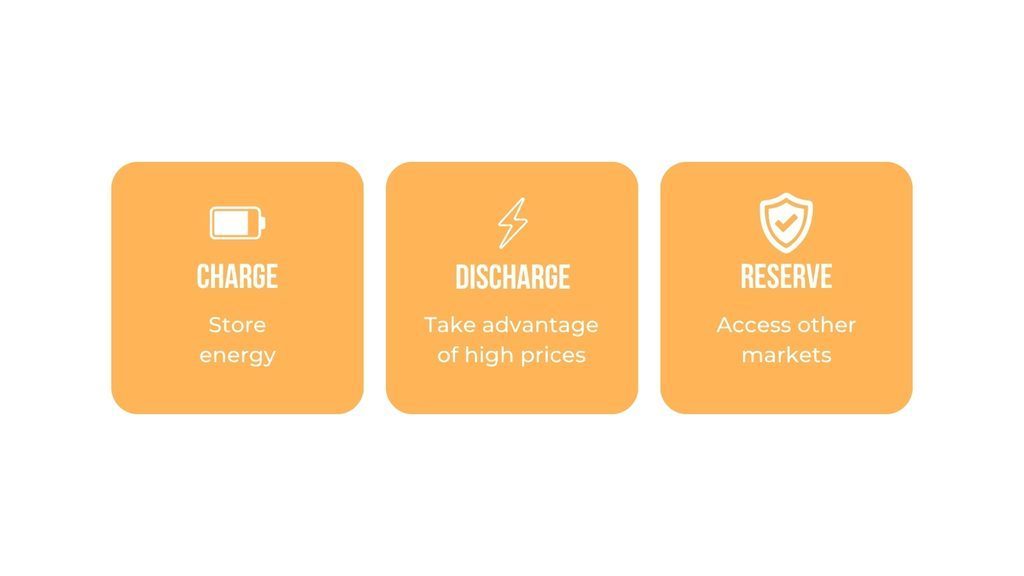
Moreover, these decisions are interconnected. Energy reserved for balancing is no longer available for arbitrage, while commitments made in the day-ahead market constrain the options available later on. Another key variable adds to this: each cycle contributes to battery degradation and consumes part of its useful life. An overly aggressive strategy can accelerate asset wear, while an overly conservative one may miss revenue opportunities across different markets, a practice known as revenue stacking.
The challenge, therefore, is not only to identify when to charge or discharge a battery, but to decide how to operate it to maximize its value over its entire useful life, balancing market opportunities, operational commitments, uncertainty, and degradation.
Optimizing under uncertainty: markets, constraints, and possible scenarios
A common way to approach this type of problem is to first make a forecast and then base a decision on it. However, when uncertainty is high, working with a single estimate may not be enough: in the case of a battery, getting the average price right is not all that matters. What also matters is anticipating when the lows and highs will occur, how far apart they will be, and what other opportunities may arise across different markets. A model that is off by five euros on average can be excellent or disastrous, depending on the period in which that error is concentrated.
The first shift is to move away from a single forecast and instead incorporate multiple possible scenarios into the optimization model. Rather than assuming a single future, we can represent different plausible market trajectories and evaluate how each decision performs under them. The optimizer does not look for the best decision for one specific future, but for the one that performs best across the full set of possible futures. If the asset manager wants to limit exposure, the model can also explicitly penalize loss scenarios.
The second shift concerns how the forecasting model is trained. With decision-focused learning techniques, the model is no longer evaluated solely on its statistical error, but also on the impact that error has on the decision. During training, it is connected to the optimizer itself, and the model measures how much money would have been lost compared to the ideal decision (decision regret). In this way, it can focus its accuracy on the elements of the forecast that actually change the outcome.
The third element is translating the battery’s physical behavior into constraints the model must respect. The state of charge must remain within safe limits, charging and discharging are subject to power limits, and each cycle involves efficiency losses. On top of these conditions come the commitments made to the system operator, which may require keeping certain levels of energy and power available.
Degradation is also incorporated as an explicit cost in the objective function, taking into account factors such as depth of discharge, power, and temperature. As a result, the model does not simply seek to capture every market opportunity, but to do so only when the expected margin outweighs the impact of operation on the battery’s useful life.
From finding a solution to justifying it
In applied research in an industrial setting, finding a good solution is only part of the problem. The recommendation must also be understandable and justifiable to the people responsible for making the decision.
Mathematical optimization offers an important advantage over black-box approaches: decisions are driven by explicit objectives and constraints. If the model recommends not discharging a battery during an hour of high prices, it is possible to analyze whether that decision stems from a commitment made in another market, the expectation of a later opportunity, or the cost associated with asset degradation.
This traceability allows technical and business teams to understand which scenarios shaped a decision, which constraints limited it, and what would have happened under other alternatives, without losing the agility required by a market that now operates in 15-minute intervals.
In practice, auditing the model means being able to answer three questions for every decision: which market scenarios justify it, which physical or regulatory constraints shape it, and what the cost of choosing a different option would have been. Tools such as sensitivity analysis, constraint shadow prices, and comparison with counterfactual scenarios make it possible to translate these answers into concrete figures.
This ability to explain and justify results becomes especially important when dealing with high-value assets and decisions that must be made repeatedly in a constantly evolving market.
Applied research: from model to impact
Moving from academia to industry does not mean abandoning research, but subjecting it to new demands. Looking back, what has surprised me most is not the technical difficulty, but the shift in criteria.
Energy storage is a good example of this transfer. Techniques such as stochastic optimization, decision-focused learning, and degradation modeling have a long research track record. Their value emerges when they are combined with knowledge of the asset and the market, and adapted to the specific rules of real-world operations.
This is also one of the areas we focus on at Baobab AI: turning analytical capabilities and scientific knowledge into tools that support better decision-making. In an increasingly variable energy system, value lies not only in anticipating what might happen, but in deciding how to act across different scenarios, balancing profitability, operational constraints, and asset lifetime.
Ultimately, knowledge transfer becomes valuable when applied research moves beyond the model and transforms a real decision. It is precisely along this path that the Torres Quevedo program proves its worth, by enabling knowledge generated in academia to continue its journey toward new corporate R&D challenges. Because in an increasingly volatile energy landscape, having more information is only part of the answer: the real value emerges when we are able to turn it into better decisions.
Ready to optimize your operations?
This publication is part of grant PTQ2025-014433, funded by MICIU/AEI/10.13039/501100011033.


Sources
Electricity price data for Sunday, April 27, 2025: https://www.bolsamania.com/noticias/empresas/economia–el-precio-de-la-luz-repunta-este-domingo-a-1098-eurosmwh-pero-tendra-11-horas-de-coste-cero-o-negativo–19459218.html