

Every summer, the same pattern repeats itself. Stores located in tourist destinations welcome thousands of additional customers, seasonal product categories experience a surge in demand, and commercial activity intensifies over the course of just a few weeks. At first glance, this should represent the most profitable period of the year for any retail chain.
In reality, however, retail operations tell a different story. Many retailers sell significantly more products during the summer months, but higher sales do not necessarily translate into higher profits. Increased demand brings higher labor costs, greater pressure on inventory, rising transportation expenses, and a far more complex day-to-day operation. In an increasingly competitive market, where prices are kept deliberately tight to protect market share, only a handful of suboptimal decisions can turn an apparently successful campaign into a disappointing financial result.
The numbers illustrate this challenge. According to Spain’s National Statistics Institute (INE), labor costs in commercial activities increased by 5.4% year over year, while the Bank of Spain reports that net profit margins across the retail sector remain compressed between 2.5% and 3.1%. When margins are this narrow, operational excellence is no longer optional it becomes a competitive necessity.
The real challenge, therefore, is not demand itself. It is the ability to respond to that demand in a coordinated way.
Summer puts decision-making to the test
When demand changes dramatically over a very short period, virtually every department across the organization must react simultaneously.
Commercial teams adjust promotions and pricing strategies to capitalize on increased customer traffic. Operations reorganizes workforce schedules to cover peak shopping hours. Supply chain teams work to ensure products remain available on store shelves, while Human Resources recruits temporary staff to cope with seasonal demand.
When executives ask themselves how to maximize profitability in an environment where margins are increasingly constrained, the answer is rarely about cutting costs indiscriminately. Instead, success depends on deploying available resources with maximum flexibility, exactly where and when they generate the greatest value.
The problem is that, despite pursuing the same strategic objective, these decisions are usually made independently.
Each department relies on its own data, its own KPIs, and its own analytical tools. The result is an organization capable of reacting quickly to market conditions, but rarely in a synchronized manner. That lack of coordination carries a direct financial cost.
The strategic mistake isn’t pricing or workforce planning
Imagine a convenience store chain launching an aggressive weekend promotion on beverages and fresh products during July to attract additional customers. From a purely commercial perspective, the decision appears perfectly reasonable. Lower prices are expected to increase store traffic and boost total sales. Yet only a few hours after the promotion begins, long checkout lines start to form. High-demand products disappear from the shelves, replenishment teams struggle to keep pace, and the overall shopping experience deteriorates.
The promotion has succeeded but the operation has failed.
The opposite scenario is equally common, a retailer hires a large number of temporary employees based on an optimistic sales forecast. Unexpected weather conditions or external factors reduce customer traffic, sales remain below expectations, and labor costs immediately erode profitability.
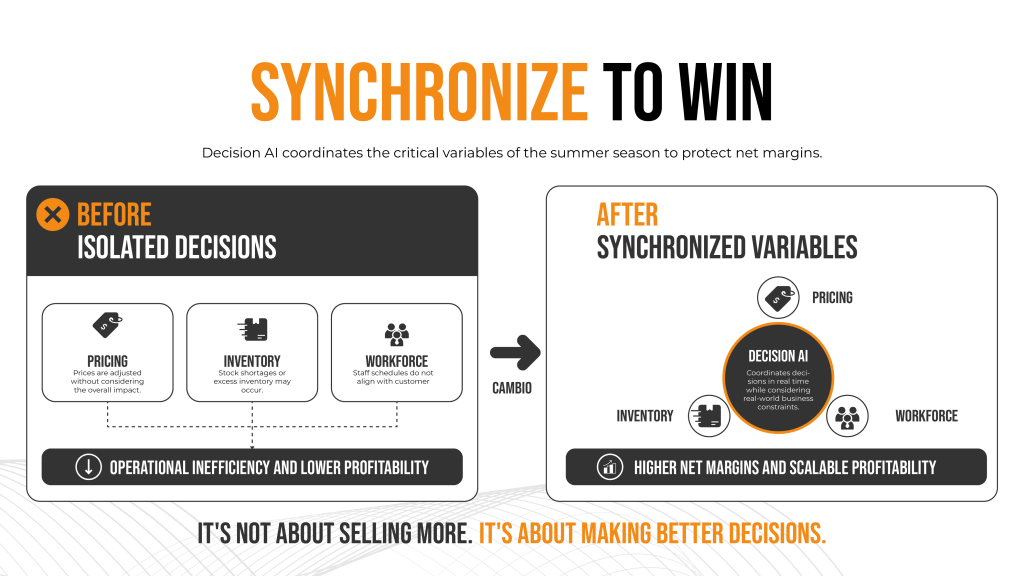
Although these situations appear very different, they share exactly the same underlying business problem.Pricing, inventory, and workforce planning have been optimized independently, assuming they are unrelated variables when, in reality, they constantly influence one another.
Every decision changes the others
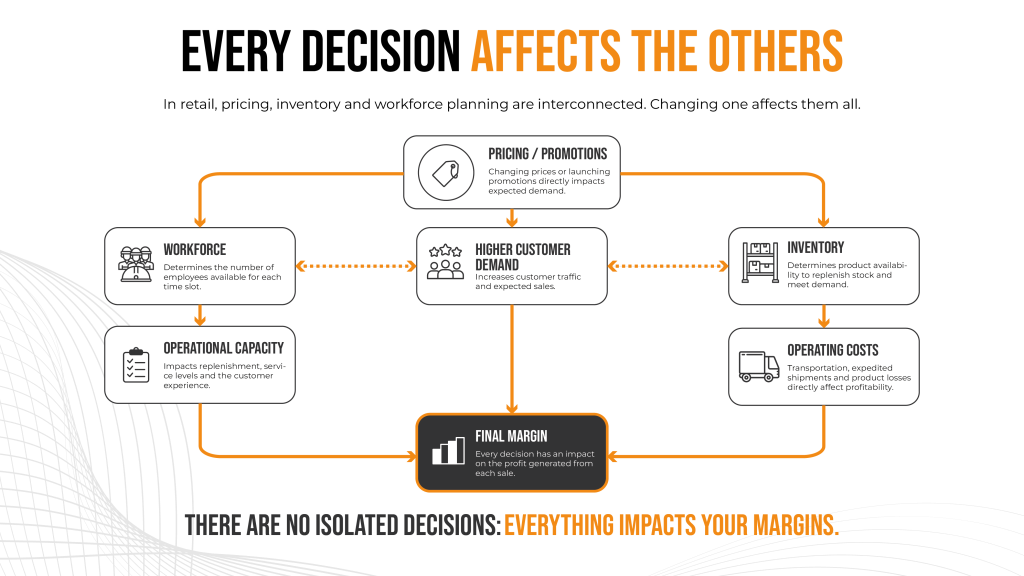
One of the defining characteristics of modern retail is that almost no operational decision exists in isolation.Changing the price of a product immediately alters expected customer demand.That change in demand directly determines how many employees are required during each shift to operate checkouts, replenish shelves, or fulfill online orders.At the same time, workforce availability determines how efficiently products can be restocked, how quickly click-and-collect orders can be prepared, and ultimately the quality of the customer experience.
Every one of these decisions ultimately impacts the net margin generated by each sale.This is why improving profitability by optimizing only one variable has become increasingly difficult.
- Reducing prices may accelerate inventory turnover, but it also compresses gross margins.
- Hiring additional staff improves service quality during peak periods, but uncontrolled labor costs can quickly eliminate the financial benefits of a successful campaign.
- Reducing workforce costs may protect margins in the short term, yet insufficient staffing often leads to empty shelves, missed sales opportunities, and lower customer satisfaction.
The real challenge is no longer determining whether an individual decision is correct.It is identifying, with mathematical precision, the optimal combination of pricing, inventory, and workforce decisions that maximizes overall business performance.
Coordinating these variables improves key retail KPIs such as conversion rates, average basket value, product availability, and customer experience by ensuring that the right product is available at the right price with the appropriate staffing levels.
It also reduces the cost of visual out-of-stocks, minimizes seasonal inventory obsolescence, and better synchronizes demand planning with replenishment operations. Retailers can therefore reduce waste while avoiding aggressive end-of-season markdowns, whether that’s beach chairs still on display in late September or Christmas trees being sold at half price after the holiday season.
Rather than maximizing individual departmental KPIs, retailers maximize overall profitability.
When operational complexity exceeds human capability
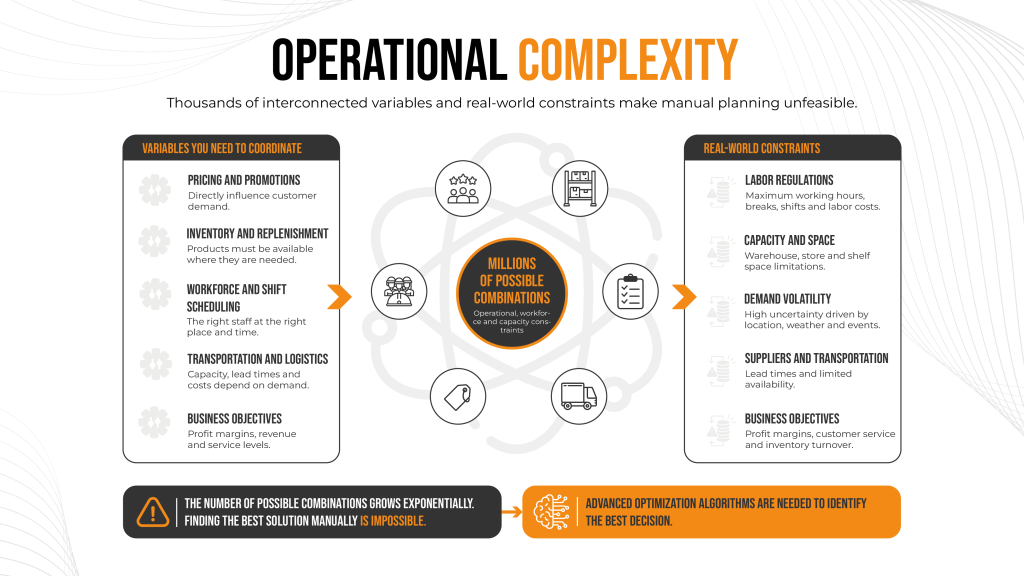
A decade ago, seasonal planning could largely rely on store managers’ experience combined with historical sales analysis. Although uncertainty always existed, the number of variables remained manageable.Today’s retail environment is fundamentally different.Every store exhibits unique demand patterns driven by local weather conditions, tourism, demographics, purchasing behavior, and geographic location. At the same time, retailers manage thousands of active SKUs while attempting to balance customer service, inventory availability, labor costs, and financial performance simultaneously.
Operational planning has become exponentially more complex than traditional spreadsheet-based approaches can realistically handle.
From data analysis to decision-making with Decision AI
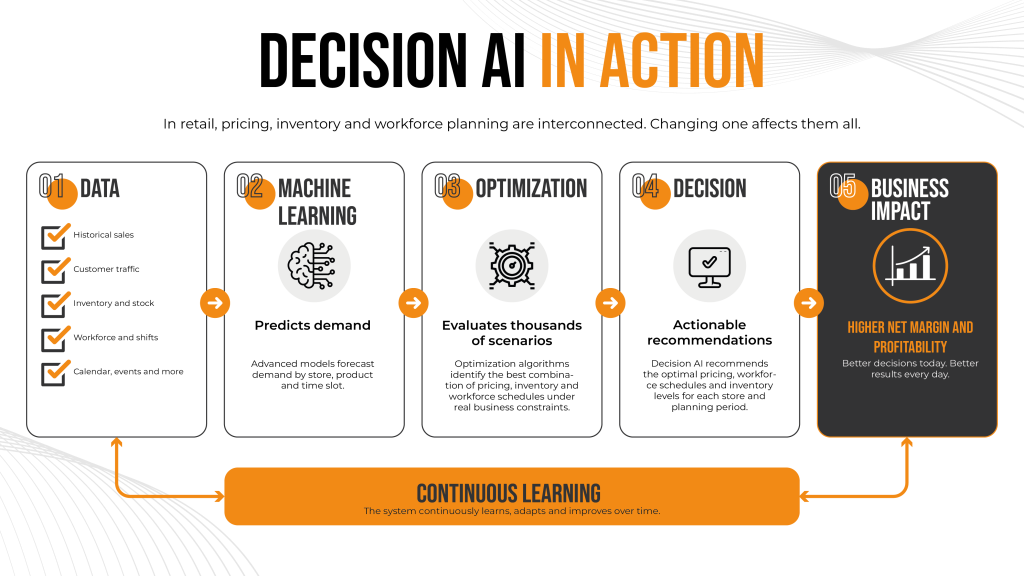
Most retail organizations already possess vast amounts of structured information about historical sales, customer traffic, inventory levels, and operational performance. The strategic challenge has changed. The bottleneck is no longer collecting data it is making better decisions with it. This is where Decision AI introduces a fundamentally different approach from traditional analytics.
Rather than stopping at demand forecasting, Decision AI combines predictive Machine Learning models with advanced mathematical optimization algorithms. Its objective is not simply to estimate what is likely to happen, but to recommend the specific actions that maximize business value while respecting the organization’s operational constraints.In retail, this means connecting decisions that have traditionally been managed in separate silos.
- Integrated planning. Demand forecasting becomes much more than a commercial estimate. It serves as the numerical foundation upon which workforce schedules, replenishment plans, and logistics requirements are optimized simultaneously.
- Workforce Scheduling Optimization: Employee schedules are automatically adjusted to forecasted demand peaks, ensuring sufficient staffing during the most profitable periods while avoiding overstaffing during off-peak hours. From a more technical perspective, workforce scheduling is formulated as a Mixed-Integer Linear Programming (MILP) problem. The model represents scheduling decisions using binary variables, mathematically defined as xe,j,t∈{0,1}x_{e,j,t} \in \{0,1\}xe,j,t∈{0,1}, where a value of 1 indicates that employee e is assigned to shift j during time period t, and 0 otherwise. Under this framework, legal constraints—such as mandatory rest periods and collective bargaining agreements—as well as human factors, including work-life balance considerations and the learning curve of temporary staff, are expressed as linear constraints that the optimization solver must satisfy simultaneously. The result is a feasible workforce schedule that minimizes labor costs associated with excess capacity or staffing shortages while ensuring operational requirements are met.
- Constraint-Aware Dynamic Pricing: Pricing and promotional strategies are optimized while taking into account the actual capacity of the supply chain, preventing demand from being stimulated for products that are at risk of stockouts. From a more technical perspective, optimal pricing is integrated into the optimization model by addressing the non-linear nature of demand through piecewise linearization techniques. This approach approximates each product’s price elasticity curve, allowing price to be treated as a continuous decision variable whose objective is to maximize gross margin. What truly distinguishes Decision AI is its unified architecture: the estimated sales volume associated with a given price ppp is automatically transformed into the dynamic workload parameter LtL_tLt for the workforce scheduling model. As pricing strategies change, the system immediately captures their impact on customer demand and updates the right-hand side of the workforce scheduling constraints. The optimization engine then recalculates the binary staffing variables in real time, ensuring that workforce capacity adjusts to the new demand without increasing operating costs or compromising the customer experience.
The robustness of this approach is supported by real-world operational evidence. International research from leading strategy consulting firms shows that algorithmically integrating workforce management with commercial decision-making can reduce unexpected cost variability by up to 12% (Gartner, Market Guide for Retail Workforce Management Applications).
This is far from being a theoretical concept. Global retailers such as the UK-based Morrisons and the US grocery chain H-E-B have successfully implemented unified analytics platforms that break down traditional organizational silos by connecting dynamic pricing engines with workforce scheduling systems. These platforms continuously process price elasticity models in real time and, whenever a promotional campaign is expected to drive a significant increase in customer traffic, automatically recalculate staffing requirements for cashiers and shelf replenishment teams during peak trading hours. The result is a synchronized operation that improves customer service while protecting profitability. According to McKinsey, this type of coordinated decision-making can increase gross profit across optimized product categories by 2% to 5% (The Economic Potential of Advanced Analytics in Retail), while simultaneously reducing checkout queues, minimizing stock availability issues, and safeguarding operating margins.
No two retailers are the same
Every retail business operates under its own unique combination of rules, priorities, and operational constraints.A supermarket chain may prioritize product freshness and minimizing shelf stockouts.A fashion retailer may instead focus on accelerating inventory turnover while minimizing inter-store transportation costs.
Local labor agreements, municipal opening hours, warehouse capacity, shelf space limitations, supplier constraints, and corporate financial objectives all influence how decisions should be made.This is why standardized, one-size-fits-all software rarely captures the true complexity of retail operations.Real value emerges when optimization models are designed around the company’s specific decision-making processes, not when businesses are forced to adapt their operations to fit generic software.
Synchronizing decisions to win the summer season
Success during the summer campaign can no longer be measured solely by sales volume or customer traffic.The true indicator of success is the ability to protect and maximize net margins in an increasingly volatile environment.Continuing to manage pricing, inventory, and workforce planning as isolated functions is no longer sustainable. Every disconnected decision increases operational inefficiency and erodes profitability.
Decision AI enables retailers to break down these organizational silos by coordinating every critical decision in real time.Pricing strategies, inventory allocation, replenishment planning, workforce schedules, and operational constraints become part of a single optimization process focused on one objective: maximizing business performance. Rather than simply responding to seasonal demand, retailers gain the ability to anticipate it, coordinate every available resource, and consistently make the best possible decisions.


