
Álvaro García Sánchez, Guillermo González-Santander de la Cruz and Antonio González Suárez, from the Baobab team, have contributed as authors to the new Springer Handbook of Data Engineering with the chapter “Predictive Analytics Models and Machine Learning”. The handbook brings together international professors, researchers and experts to address the main challenges and applications of data engineering.
This contribution recognizes the knowledge and expertise the team has built in predictive analytics and machine learning, and strengthens Baobab’s ties with the academic community. It also reflects a core working principle: the knowledge we generate through research is the same knowledge we build into our platform.
The contribution to the Springer Handbook of Data Engineering
by Guillermo González-Santander de la Cruz
Springer is one of the world’s leading scientific and technical publishers. Its Handbooks bring together, in a single volume, the established body of knowledge in a discipline. Researchers and practitioners turn to them when they need a solid foundation on a subject. Writing for a work of this kind is a form of recognition for Baobab in this field, as well as a reflection of our commitment to sharing knowledge. This type of publication also carries a responsibility: the text must stand the test of time and be useful to readers with very different profiles.
Our involvement came about through an invitation from the volume editor, at the suggestion of other authors of the book. We had collaborated with them on several occasions, and they believed it would be valuable for Baobab to share the results of years of work in predictive analytics and machine learning, both in client projects and in our own research lines.
The publication arrives at a particularly relevant time. Data engineering now plays a central role in organizations that aim to make rigorous, well-founded decisions. This is compounded by a rapidly changing landscape: the volume of available information keeps growing, the range of tools and platforms is ever wider, and artificial intelligence is evolving at an unprecedented pace. In this context, a reference handbook is especially valuable, as it helps organize concepts, establish common criteria and distinguish established practices from passing trends.
Our chapter, “Predictive Analytics Models and Machine Learning,” reviews the main models for anticipating behaviors and outcomes from data, from classical statistical approaches to machine learning techniques. It also explains how to select, train and evaluate these models. Our aim is for it to serve as a practical and rigorous guide for anyone who needs to move from data to a prediction they can trust.
Predictive Analytics Models and Machine Learning: from knowledge to real-world problems
by Antonio González Suárez
The chapter addresses the three main types of predictive problem: classification, regression and time series forecasting. The latter takes center stage because of its relevance to industry. Anticipating demand, consumption or activity over the coming weeks is a common planning requirement and calls for a specific approach, since the temporal order of the data shapes the entire process.
In practice, choosing a model involves decisions that theory alone cannot resolve. One is whether to opt for classical statistical models, such as ARIMA or Prophet, or for machine learning models, such as XGBoost or LightGBM. Another is whether to train one model for each forecasting horizon or a single model applied recursively. The second option simplifies maintenance but accumulates error as the horizon extends. The chapter compares these alternatives and their implications, since there is no one-size-fits-all solution.
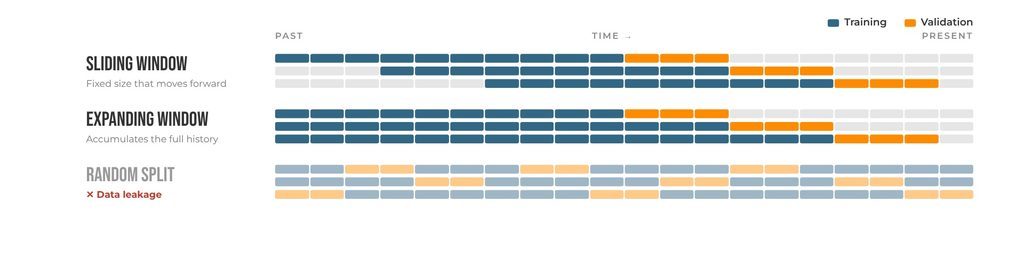
The second challenge is verifying the model’s real-world performance. With time series, a validation that does not respect the order of the data introduces future information into training and produces results that are more optimistic than those that will be achieved in production. The chapter devotes a section to validation with sliding and expanding windows, to preventing this data leakage, and to selecting metrics aligned with business objectives.
Finally, the data must be transformed so the model can learn from it: historical values, moving averages, calendar variables, holidays or external factors. This stage often has a greater impact on the outcome than the choice of algorithm.
This is exactly what we do at Baobab: start from the real-world problem, choose the approach that fits the available data, validate it rigorously, and then turn the forecast into planning decisions with our optimization models.

Beyond the publication: connecting research and business
by Álvaro García Sánchez
At Baobab, research is part of how we work. The problems industrial companies face (planning, forecasting, allocating resources or making decisions under uncertainty) rarely lend themselves to standard solutions. Tackling them requires a solid grasp of the state of the art: which methods exist, which are effective and under what conditions. That is why we continuously follow the scientific literature, as the foundation for delivering the most suitable solution in each case.
But we do not stop at consuming knowledge: we also generate it. At Baobab, we drive our own research initiatives, financed with our own funds and, in some cases, with partial support from public funding. These include industrial PhDs, Torres Quevedo contracts and research projects, some in collaboration with other partners and others carried out entirely by our team. Through these lines of work, we aim to go one step beyond what has already been solved and explore approaches that are not yet applied in industry.
Real-world projects involve incomplete data, legacy systems, operational constraints and users who need to trust the results. That experience gives rise to research questions that would rarely emerge in a purely academic setting. In turn, research feeds back into the platform in the form of more robust models and more precise criteria for when to apply each technique.
The two paths reinforce each other. Client projects confront us with incomplete data, legacy systems, operational constraints and users who need to trust what we propose. That experience leads us to research questions that would rarely emerge in a purely academic setting. In turn, what we learn through research flows back into our projects in the form of more solid models, better-grounded methods and sharper criteria for knowing when a technique is the right fit and when it is not.
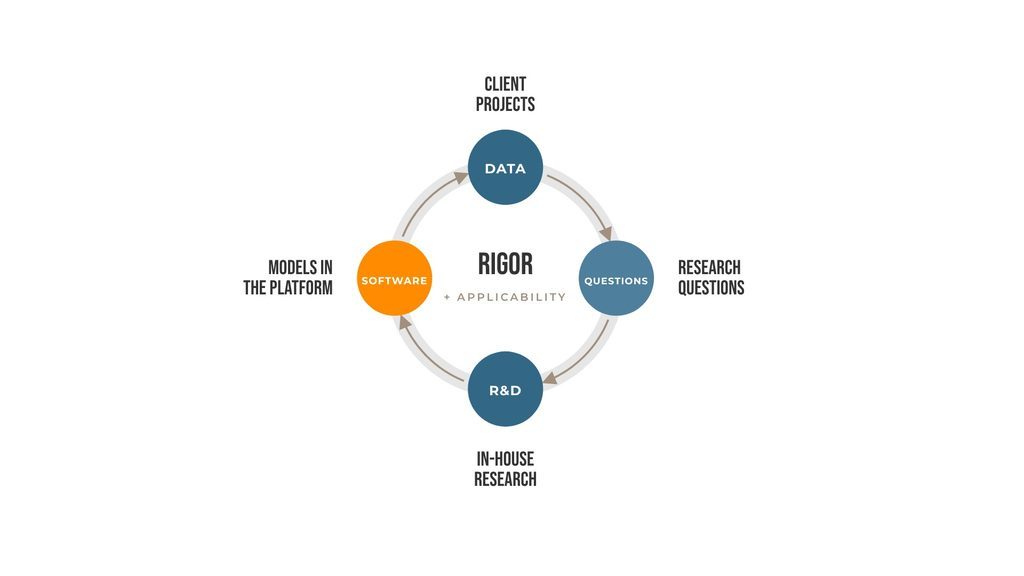
This dual perspective, academic and business, allows us to maintain rigor without losing sight of applicability. The knowledge our team generates translates into solutions for our clients and, at the same time, is given back to the scientific community through publications, collaborations and the training of new researchers.
Our contribution to the Springer Handbook of Data Engineering is a good example of this cycle. The chapter brings together what we have learned by studying the literature and applying it to real-world problems, and makes it available to other professionals and researchers. For us, this is the best way to understand the relationship between business and research: an ongoing conversation in which both sides benefit.