

I’ve spent over seven years leading optimization projects across logistics, energy, retail, manufacturing, and pharma. Throughout this time, I’ve noticed a recurring theme at the start of almost every engagement: companies arrive fully convinced they need “Artificial Intelligence,” yet they lack a clear understanding of which type they need—or why.
This isn’t a matter of ignorance; it’s a symptom of how the market has evolved. For years, we’ve discussed AI as a monolithic entity, when in reality, we are dealing with technologies that possess entirely different natures, logics, and use cases.
This confusion carries a tangible cost. Companies often invest in the wrong tool for the problem at hand, yield mediocre results, and ultimately conclude that “AI just doesn’t work.”
This article is an attempt to cut through the noise and bring some much-needed clarity to that conversation.
Two technologies, two distinct logics
When we talk about AI in a business environment, there are two major categories that need to be distinguished: Generative AI, or GenAI, and the AI responsible for enhancing decision-making, which we at Baobab AI call Decision AI.
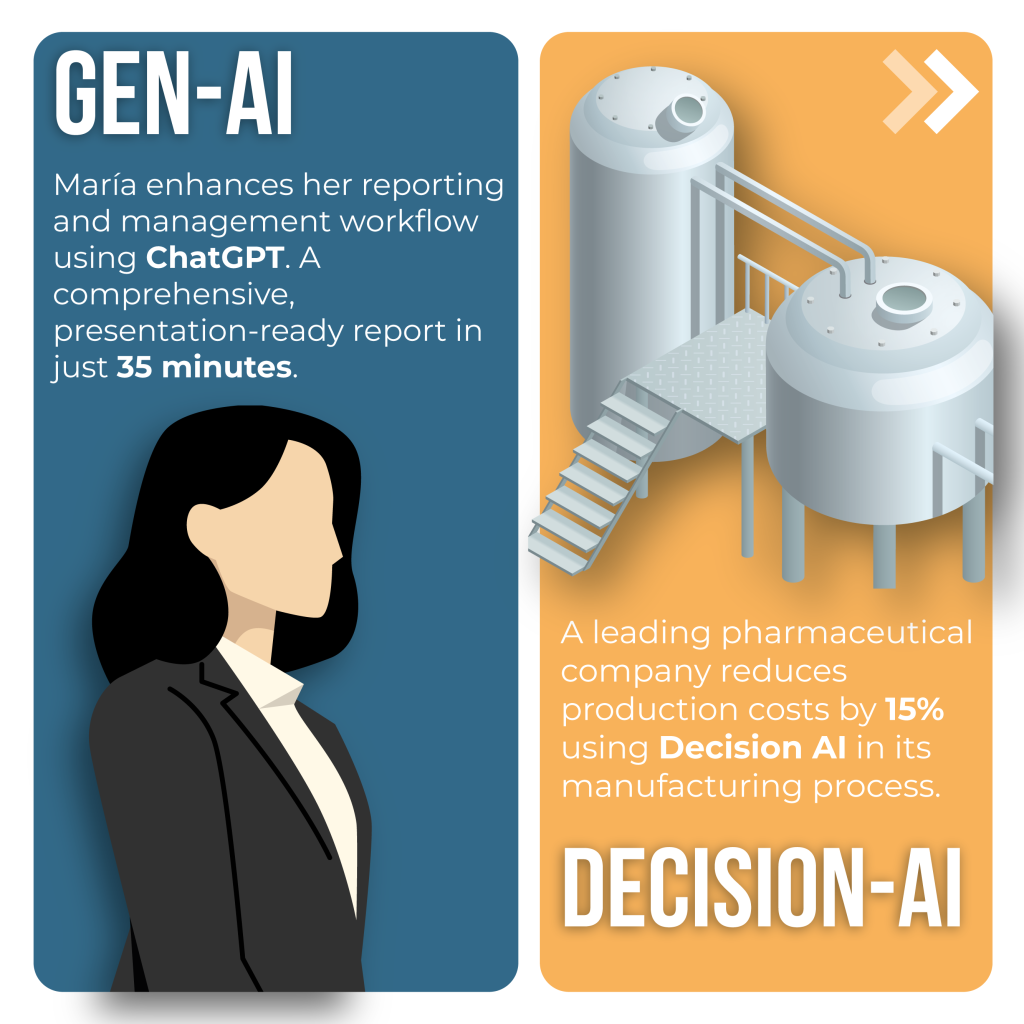
GenAI is what most people are familiar with. It is the technology behind tools like ChatGPT: you ask a question, it interprets the context, and it generates a response. It operates based on language models trained on massive volumes of data, and its strength lies in its fluency. It can write, summarize, translate, answer questions, and generate content quickly and naturally. It is, as I like to put it, like having an assistant who knows a bit about everything and is available to answer any question at any time.
Its day-to-day value is undeniable. A sales team using GenAI to draft proposals, a marketing department using it for creative briefs, or an executive summarizing long reports in minutes—they are all seeing a real return. GenAI makes things faster. That, in itself, is a major breakthrough.
However, it has a clear limit: it is not designed to solve complex operational problems. And this is where Decision AI comes in.
Decision AI operates on a completely different logic. Its foundation lies in Mixed-Integer Linear Programming (MILP) models—a branch of applied mathematics with decades of development behind it. Without getting too bogged down in technicalities, these models represent a real-world system with all its variables, constraints, and objectives, exploring every possible solution to find the optimal one. It doesn’t just learn from historical data to replicate past behavior; it understands the rules of the system and uses them to improve results far beyond what any human could achieve manually.
The best example to illustrate the difference
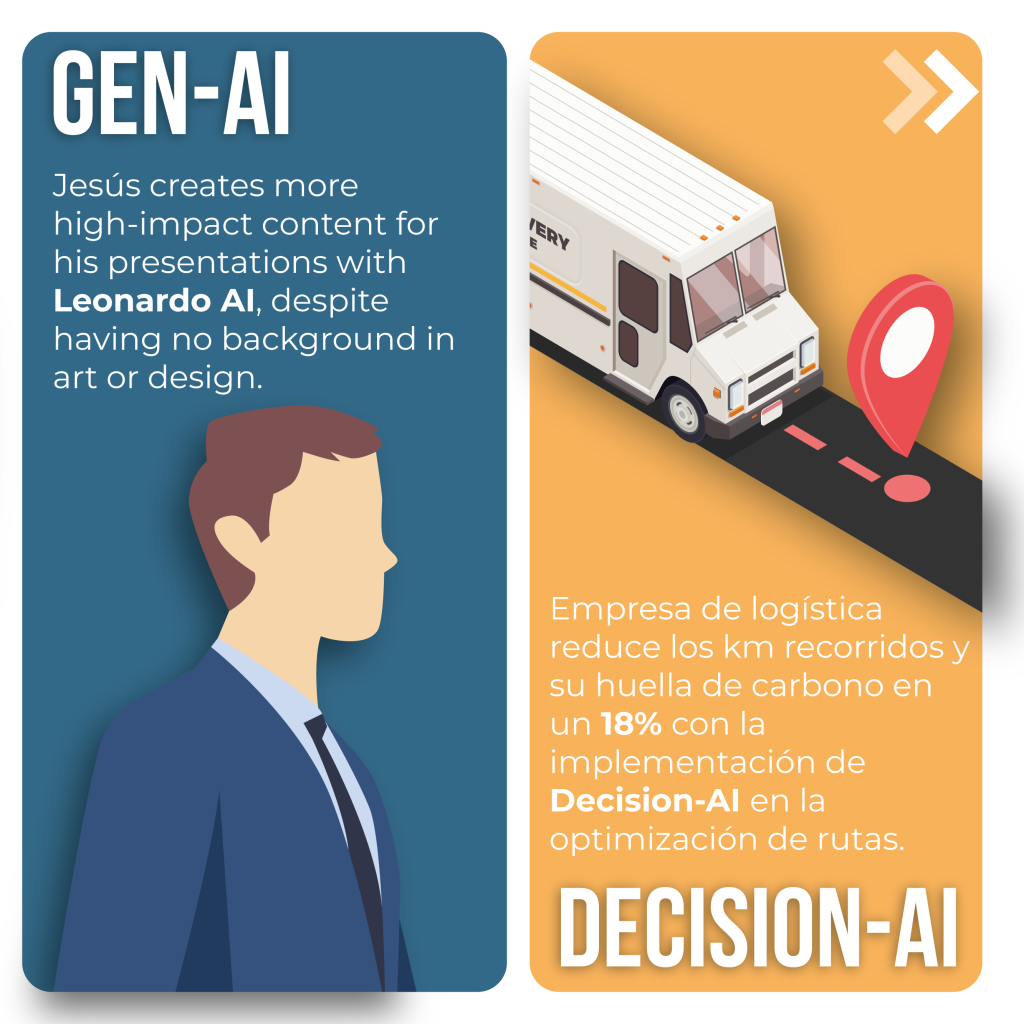
Imagine a courier company handling 400,000 shipments a day. They have a fleet of vehicles, a network of warehouses, strict delivery windows promised to customers, and fuel costs that never stop rising. Every morning, someone must decide which vehicle takes which route, in what order, and with what load.
A GenAI tool can help that team communicate better, summarize incidents, or draft the end-of-day report. However, it cannot tell you the optimal combination of routes and vehicles that minimizes total cost while meeting every delivery commitment. The possible combinations run into the millions. A human cannot evaluate them all. A Decision AI model can.
When we talk about companies with revenues in the tens or hundreds of millions of euros, a 5% or 10% improvement in routing efficiency isn’t just a minor detail. It’s an impact that justifies the investment many times over.
I have worked on vehicle routing projects, inventory management, national-scale oil supply chains, university scheduling, and maritime distribution. These are vastly different problems, but they all share one thing: they are systems with definable rules, a clear objective, and a margin for improvement that manual solutions simply cannot capture. This is precisely where Decision AI thrives.

Which AI technology is more transparent?
There is a distinction between GenAI and Decision AI that goes beyond technical specs—one that, in my experience, resonates most deeply with leadership: process transparency.
GenAI operates as a “black box.” We know what we ask it and we see the output, but the intermediate process is not auditable. This isn’t a problem when you’re using the tool to draft an email or summarize a document. However, it becomes a major issue when a decision carries significant operational or economic weight. In those cases, we need to know exactly why the system reached a specific conclusion.
Decision AI works the opposite way. Every constraint in the model is explicitly defined by the team building it. Every variable is visible. All result is traceable. If the model recommends closing a warehouse or adjusting a product’s replenishment frequency, we can point to the exact data points and rules that led to that recommendation. You might agree with it or not, but you can challenge it based on hard logic.
For a company operating in regulated sectors, reporting to a board of directors, or simply wanting to maintain control over its technology, this transparency isn’t a luxury. It’s a requirement.
Are they compatible? More than that: they are complementary
A question that often comes up is whether it makes sense to implement both technologies simultaneously. The answer is a definitive yes—in fact, I believe this combination is exactly where the market is heading.
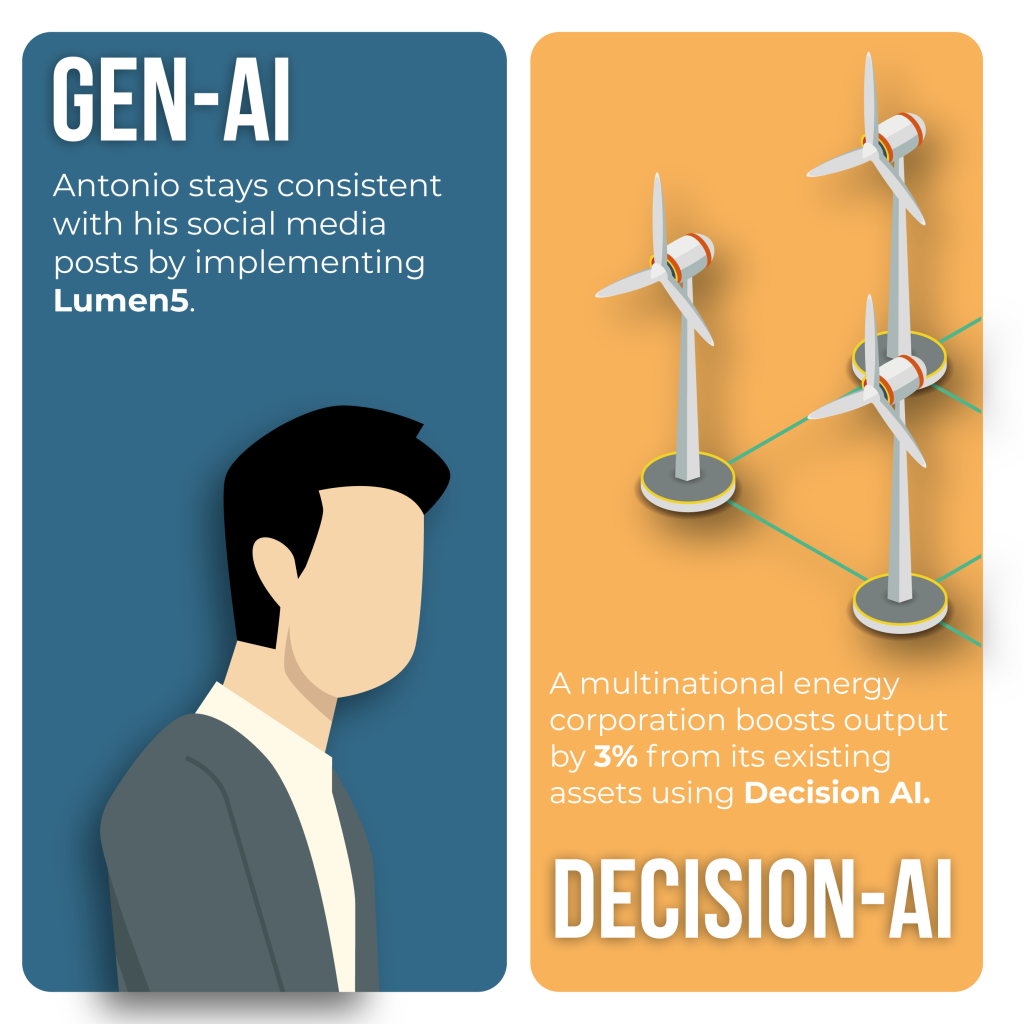
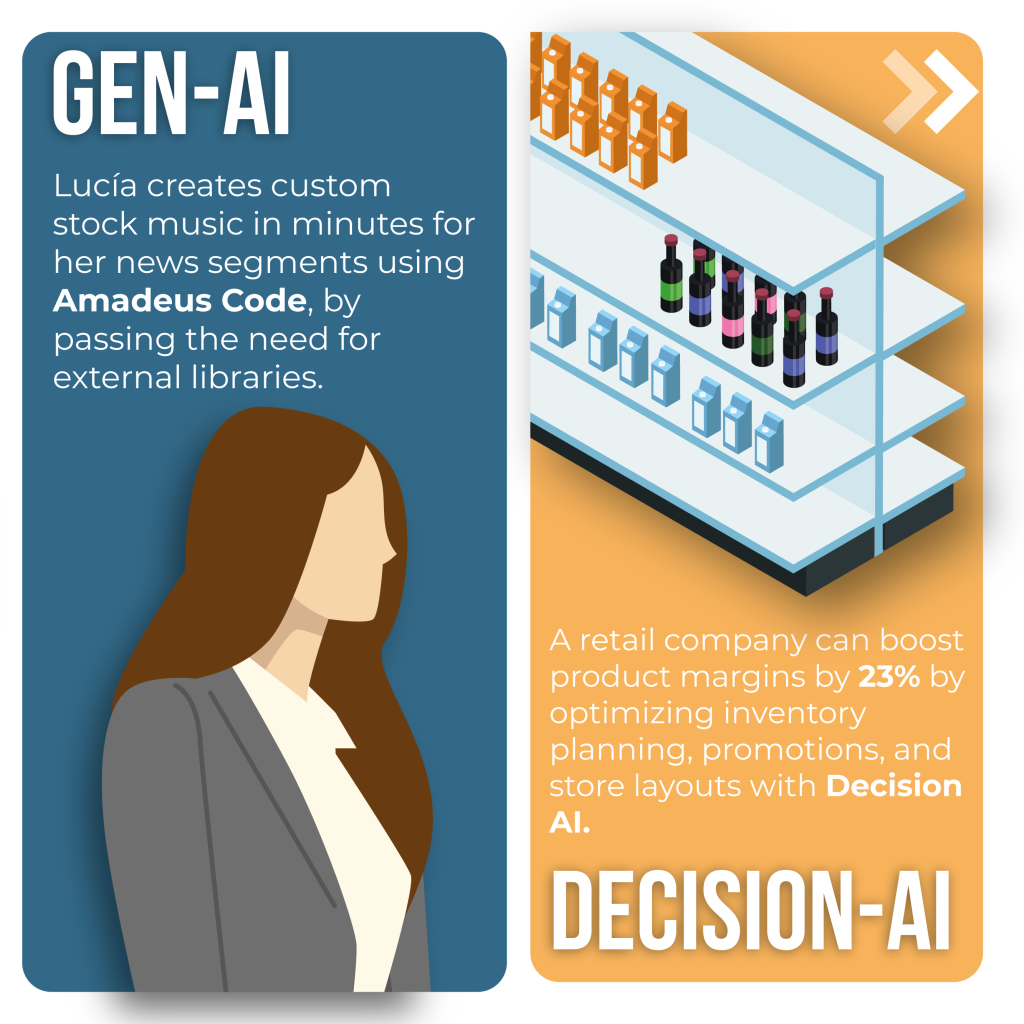
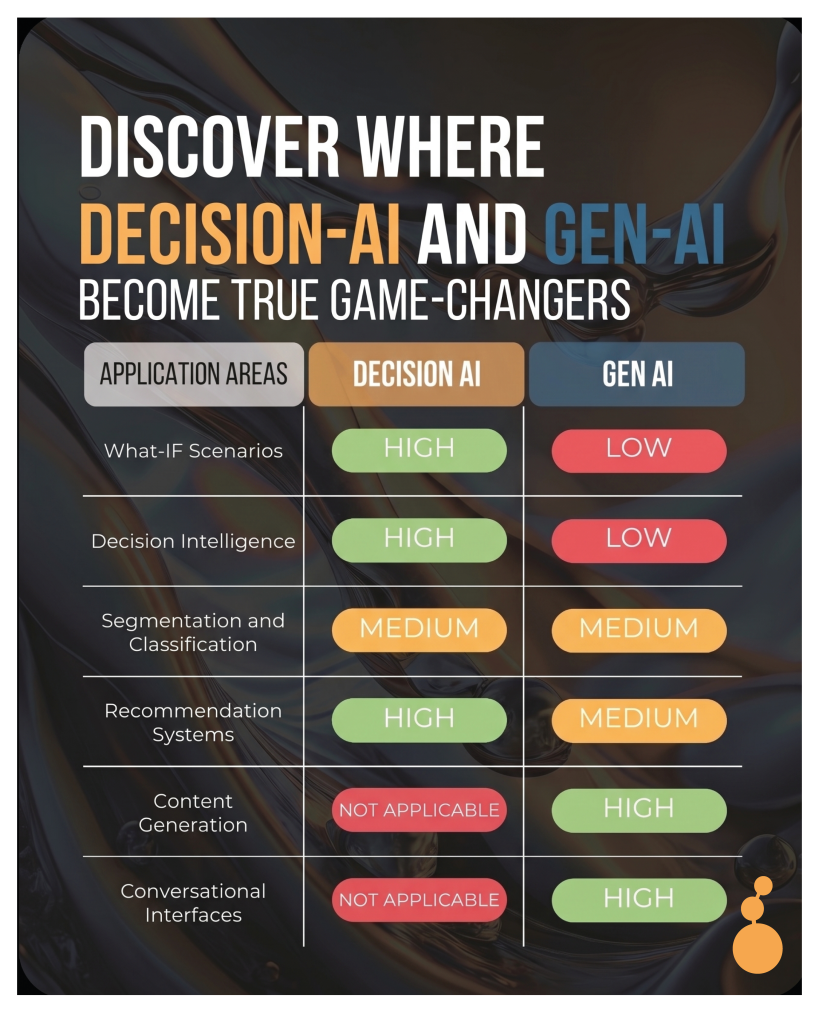
Each technology has its own natural domain. GenAI is extraordinary for anything involving language, communication, and efficiency in knowledge-based tasks. Decision AI is irreplaceable when the problem is operational, complex, and carries a clear economic impact. They don’t compete; they complement each other.
In fact, we are already seeing the first applications where both work together in an integrated way: an optimization model solves a complex scheduling problem, and its results—which would otherwise be raw data, tables, and mathematical parameters—are interpreted by a Generative AI. The GenAI then converts that data into a natural language report that any executive can read, understand, and act upon. It’s the best of both worlds.
Which AI should you invest in? start with the problem
If you are considering implementing AI, the question isn’t which tool is trendier, but rather: what problem are you trying to solve?
If your goal is to improve communication, speed up documentation, or automate knowledge-based tasks, GenAI is your best ally. It will make your teams faster and more articulate.
However, if you are facing a “puzzle” where every piece costs money—like logistics, production scheduling, or resource allocation—Decision AI is the only tool that will give you the mathematical certainty of an optimal result.
In my experience, the most successful companies don’t just “buy AI”; they identify their most expensive bottlenecks and then choose the specific logic—generative or mathematical—that can solve them.
Before your next investment, ask yourself: are we trying to generate content, or are we trying to optimize a decision? The answer to that question is the difference between a mediocre experiment and a transformative competitive advantage.


